Fragile X syndrome is a chromosomal disorder that affects the sex chromosomes, specifically the X chromosome.
It was described only a few years ago. It is the second most common chromosomal disorder, the second most common cause of intellectual disability due to an inherited syndrome (surpassed only by Down syndrome) and the most common cause of intellectual disability in males.
Other relevant facts about fragile X syndrome:
- Frequency: 1/4,500 in males and 1/9,000 in females. Although it is X-linked dominant, in genetics it was stated that penetrance in females is 50%, which explains why the frequency is half that in males.
- Inheritance: dominant, linked to X, or variable penetrance.
- 1/10,000 women are carriers, so it is easy for the triplet to expand from the mother during meiosis and cause the disease in one of her children.

Remember that this lesson is part of the free courses from Paradigmia. Access the full course below 👇👇 PAEDIATRICS COURSE
- Genetic cause of fragile X syndrome
- Karyotype of patients with fragile X syndrome
- Fragile sites on the X chromosome
- Number of trinucleotide copies
- Inheritance of fragile X syndrome
- Fragile X syndrome in males
- Fragile X syndrome in females
- Clinical features of fragile X syndrome
- Suspecting fragile X syndrome
- Fragile X syndrome in females
- Treatment of fragile X syndrome
- Fragile X syndrome and fertility
- Recommended reading:
Genetic cause of fragile X syndrome
The genetic origin of this syndrome is a type of mutation caused by the expansion of trinucleotide repeats, as a result of which the offspring of the person in whom the mutation occurs will have an increased number of repeats of 3 nucleotides (1 trinucleotide = 3 nucleotides). Many diseases are caused by this phenomenon.

With each generation, the increase in the number of copies of this trinucleotide becomes more frequent, so the disease appears earlier and is more severe. This phenomenon is known as anticipation.
The mutation responsible for fragile X syndrome is in the FMR-1 gene, located on the X chromosome. The CGG trinucleotide (cytosine-guanine-guanine) expands in the regulatory region of this gene.
However, the disease does not manifest until a threshold number of repeats is exceeded. In this syndrome the threshold is 230 repeats. When this threshold is reached, a phenomenon known as methylation occurs in that part of the DNA strand, causing the gene to lose its function.

The FMR1 gene encodes the FMRP protein, which is responsible for the correct synapses of neurons. The mutation therefore silences the FMR1 gene, causing intellectual disability and the behavioural abnormalities typical of this syndrome.
Karyotype of patients with fragile X syndrome
The karyotype is normal, with no abnormalities.
The abnormalities are seen only when the patient’s lymphocytes are placed in a stressful medium that is poor in folate and thymidine and are then induced with methotrexate, which gives chromosome breakpoints that resemble chromosomal satellites.
Fragile sites on the X chromosome
We said earlier that the disease is caused by expansion of the CGG triplet because this is the most common. However, there are 2 regions in which these amplifications mainly occur:
- Region Xq 27.3: the CGG triplet expands in this region (cytosine-guanine-guanine: CGG-CGG-CGG-CGG…).
- Region Xq 28 : the CCG triplet expands in this region (CCG-CCG-CCG-CGG …).

Number of trinucleotide copies
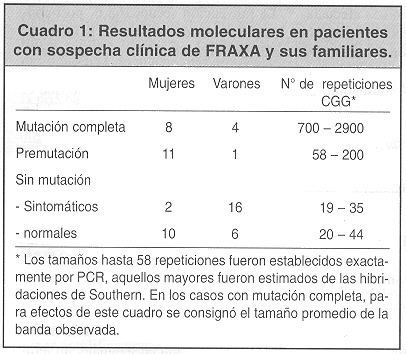
The number of copies of the CGG trinucleotide in region Xq 27.3 of the X chromosome in a normal individual is between 5 and 40 copies. However, as this number of repeats increases, we approach the threshold beyond which methylation will occur, leading to inactivation of the gene.
In addition, as we said at the start of this lesson, over the generations these amplifications occur in the offspring more rapidly and more severely, so the disease begins at younger ages. This was the phenomenon of amplification.
Depending on the number of copies of the triplet, the individual will be:
- Carrier: when the CGG sequence is repeated between 45 and 200 times. This condition is called a premutation, and the person who has it does not develop the disease (the gene continues to work). However, they can pass it on to their offspring, with the consequent risk that the offspring will be affected.
- Case, full mutation or affected individual: the affected person has more than 200 repeats, which is considered a full mutation. In this case symptoms do develop, to a greater or lesser degree.
Remember that this lesson is part of the free courses from Paradigmia. Access the full course below 👇👇 PAEDIATRICS COURSE
Inheritance of fragile X syndrome
It is a dominant mutation, but the transmission of this syndrome is linked to the X chromosome.
This matters because the mutation (and the resulting inactivation of the gene) lies on a sex chromosome that is present in different numbers in males (1 X chromosome) and females (2 X chromosomes), so transmission differs between the sexes.
Fragile X syndrome in males
Because males have only one X chromosome, if they inherit the mutated chromosome from their mother (it can only come from the mother, since the father has given them the Y chromosome), the disease will ALWAYS occur.
This is why fragile X syndrome is a disease that mainly affects males, who also have the more severe symptoms.

Fragile X syndrome in females
In females it is different, because they have 2 X sex chromosomes. One of the 2 X chromosomes is inactivated, because otherwise twice as much protein would be produced from this chromosome as in males.
Let us start with the case of a carrier woman who has 2 X chromosomes, one of them mutated (she would be the third woman in the 2nd row of the previous image). In this case 2 things can happen:
- The mutated X chromosome is inactivated. In this case 100% of the protein will be synthesised by a healthy X chromosome and there will be no manifestation of the disease.
- The healthy X chromosome is inactivated. In this case 100% of the protein is produced by the mutated chromosome, whose repeats of the affected trinucleotide gradually increase. Once these repeats exceed the threshold we saw earlier, the disease will occur.
Clinical features of fragile X syndrome
Fragile X syndrome is a disease with very recognisable features, but we must always carry out a confirmatory genetic diagnosis (we will see this in the section on diagnosis).
The most characteristic manifestations of fragile X syndrome are:
- Delayed language acquisition, and when language is acquired, it is incomplete.
- Moderate to severe intellectual disability.
- Hyperactivity, restlessness and aggression: they become more aggressive when provoked.
- Autism-like disorder: autistic features.
- Phenotype. It presents with:
- Facial dysmorphism characterised by:
- Protruding ears
- Large ears
- Prominent chin, which gives the impression of a long face
- Prognathism. It gives the impression of a large head.
- Joint laxity.
- They do not usually look straight at you but to the side. When a patient with a low IQ comes to the clinic, look for these and other features and request fragile X testing if you suspect it.
- Facial dysmorphism characterised by:
- Epilepsy: above all Rolandic epilepsy.
- Macro-orchidism, which is more noticeable at puberty.
- Mitral valve prolapse


Suspecting fragile X syndrome
We will suspect this syndrome in cases with the clinical features described above and, in addition, one of the following situations:
- Familial intellectual disability. Intellectual disability with no organic cause in several family members.
- Mothers and female relatives with depression, attention disorder and difficulty socialising.
- Mothers and female relatives with premature menopause (POF) or reproductive difficulties.
- Males (maternal grandfathers) who develop ataxia and cerebellar syndrome.
If the syndrome is suspected, a chromosome study will be carried out to see whether there are breaks in the X chromosome, which may be terminal or interstitial.
Remember that this lesson is part of the free courses from Paradigmia. Access the full course below 👇👇 PAEDIATRICS COURSE
Fragile X syndrome in females
Those affected are carrier females, in whom we will see the following features:
- Normal facial features or mild abnormalities: long face, broad forehead and large ears.
- No intellectual disability (or mild intellectual disability or, exceptionally, profound intellectual disability).
- Behavioural problems (the most striking feature): hyperactivity; hand biting; easy distractibility and shyness. The first three can resemble ADHD.
Treatment of fragile X syndrome
Because this is a disease of genetic origin, there is currently no aetiological treatment available.
Fragile X syndrome and fertility
Fragile X syndrome also affects the fertility of those affected:
- If the affected person is a woman, it can cause premature ovarian failure. This is combined with a lower ovarian reserve, which can lead to early menopause in childhood. In this last case, egg donation can always be used.
- If the affected person is a man, a sperm donor is used to avoid passing the disease on to the offspring.
Remember that this lesson is part of the free courses from Paradigmia. Access the full course below 👇👇 PAEDIATRICS COURSE