It is the active element of the musculoskeletal system. Muscles are composed of different tissues, the most characteristic being muscle tissue, which has contractile capacity, that is, it is able to change its length, which results in movement.
Muscle is made up of muscle cells (= muscle fibres).
Muscle fibres are composed of longitudinal structures called myofibrils, which are made up of filaments of actin and myosin, together with a binding protein, meromyosin, which allow them to change their length.
In the following interactive resource you can see the large-scale structure of muscle:
There are 3 different types of muscle tissue:
- Smooth: found in the viscera, the vessels, the arrector pili muscles...
- Cardiac: forming the myocardium. It has a striated appearance.
- Skeletal: forms the muscles of the musculoskeletal system. It also has a striated appearance. The striations, as in cardiac muscle, are transverse.
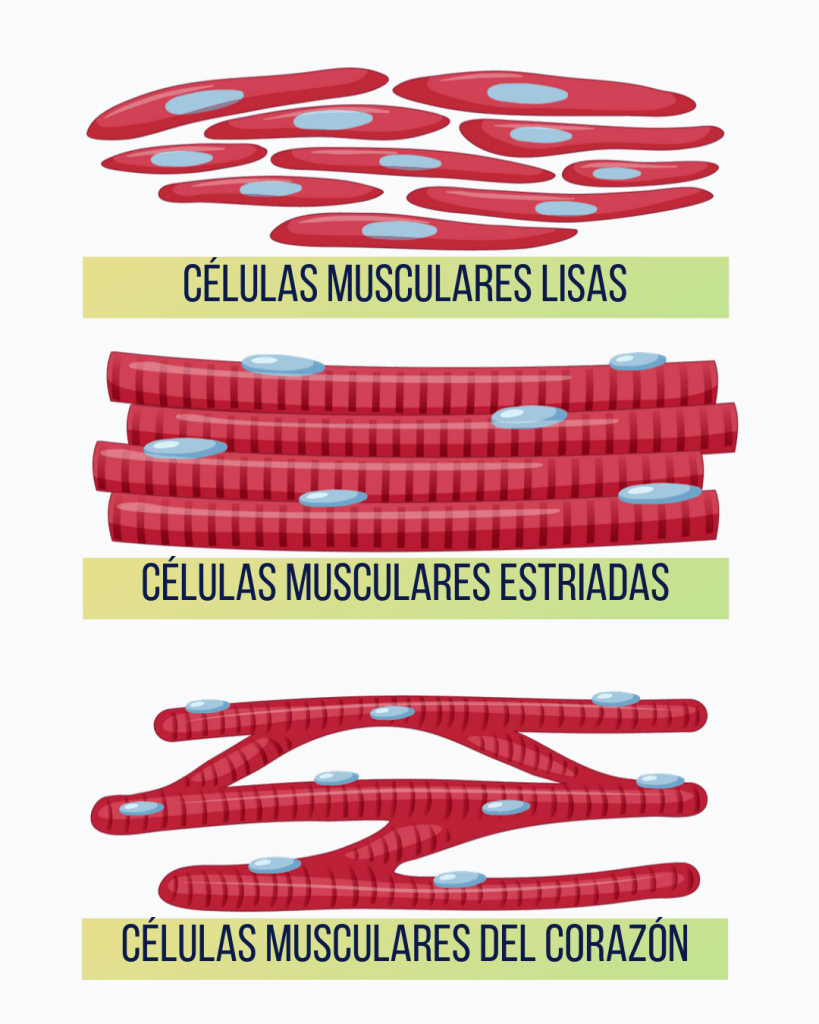
There are around 400 muscles in our body, and they make up 40% of our body weight.
Muscles are classified according to different criteria:
- Shape (flat, fusiform, circular, square, pennate (feather-shaped))
- Function
- Location
- Heads and muscle bellies (monogastric, digastric, polygastric); and by number of tendons (they can be monoceps, biceps, triceps, quadriceps)
Belly, origin and insertion of a muscle
- Belly: the muscle mass (muscle tissue). It refers to the central part of the muscle.
- Muscle origin and insertion: these are the ends, that is, the areas where the muscle is anchored to bone. The origin usually refers to the end nearest the midline or the root of the limb, whereas the muscle insertion refers to the end furthest from the root of the limb or from the midline. But sometimes these terms are used so that the end of the muscle that stays fixed during movement is called the origin, and the part that moves is called the insertion.
Forms of anchorage and attachment
The attachment of muscle to bone always occurs through fibrous connective tissue, but it can take different forms:
- Tendinous insertion: the attachment of the muscle to bone is cord-shaped (tendon). E.g. biceps, knee, finger flexors, etc.
- Aponeurotic insertion: the belly attaches via a sheet of fibrous connective tissue (aponeurosis). E.g. tensor fasciae latae, latissimus dorsi.
- Fleshy insertion: the muscle fibres appear to penetrate the bone. E.g. temporalis, deltoid.
A special case is the muscles of facial expression, which insert into subcutaneous muscle tissue.