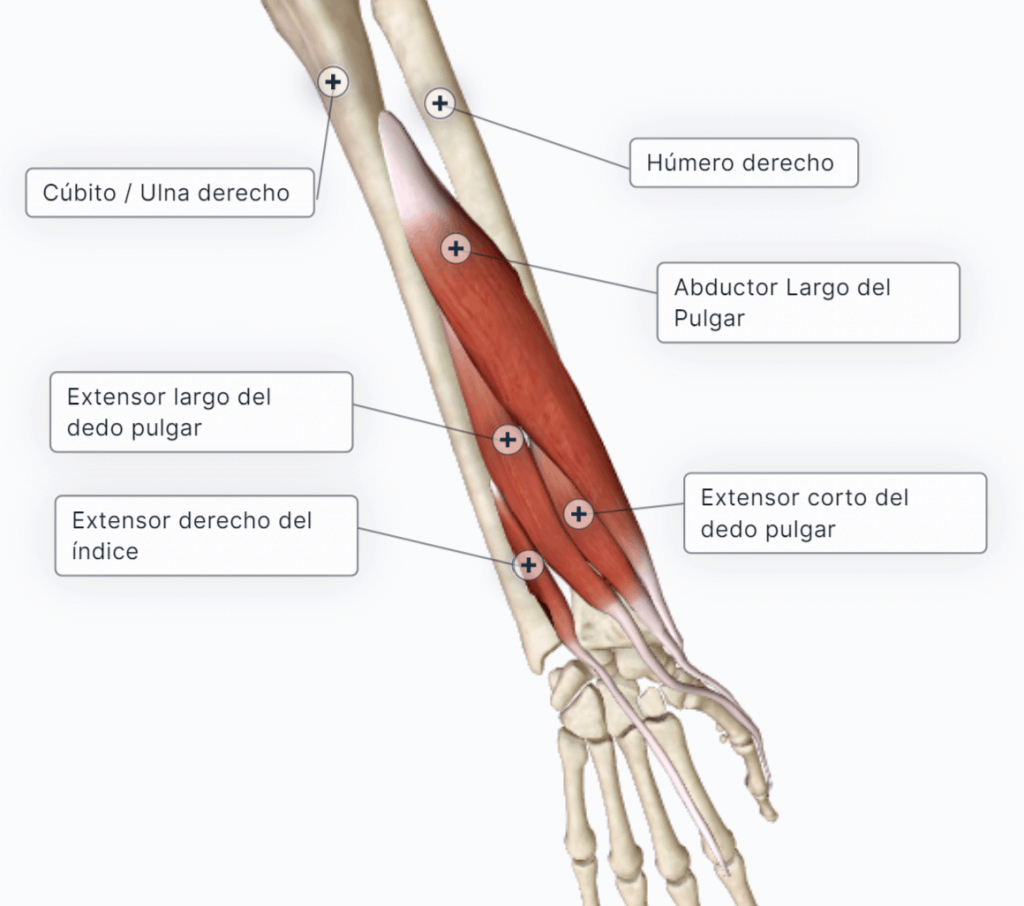
You can study all these muscles in greater depth in the Paradigmia® muscle tables
The muscles of the forearm are surrounded by the antebrachial fascia, which continues upwards with the fascia of the arm and below joins the flexor and extensor retinacula of the wrist.
From the deep surface of the fascia two septa arise, a lateral one ending on the radius and a medial one ending on the ulna, which, together with the two bones and the interosseous membrane joining them, divide the forearm into two compartments: anterior (flexors) and posterior (extensors).
In the posterior compartment, in addition, another sheet of fibrous tissue runs from the anterior border of the radius to the antebrachial fascia and in turn subdivides the posterior space into a lateral or radial compartment. This topographic division allows us to classify the muscles of the forearm by muscle compartment:

- Anterior compartment: contains muscles that are mainly flexors of the hand and fingers, together with pronator muscles. They are divided into four planes which, from superficial to deep, are:
- 1st plane: pronator teres, flexor carpi radialis, palmaris longus and flexor carpi ulnaris.
- 2nd plane: flexor digitorum superficialis.
- 3rd plane: flexor digitorum profundus and flexor pollicis longus.
- 4th plane: pronator quadratus.


- Lateral compartment: contains four muscles which, from superficial to deep, are: brachioradialis (supinator longus), extensor carpi radialis longus (first radial), extensor carpi radialis brevis (second radial) and supinator (supinator brevis). They take part in extension of the wrist, radial deviation and supination.

- Posterior compartment: contains extensor muscles. In this posterior compartment there are seven muscles arranged in two planes:
- Superficial plane: extensor digitorum, extensor digiti minimi and extensor carpi ulnaris (posterior ulnar muscle).
- Deep plane: abductor pollicis longus, extensor pollicis longus, extensor pollicis brevis and extensor indicis.