You can study all these muscles in greater depth in the Paradigmia® muscle tables
2. Extensor muscles
Extension of the elbow has a range of 10° and is performed by triceps brachii and anconeus.

2.1 Triceps brachii
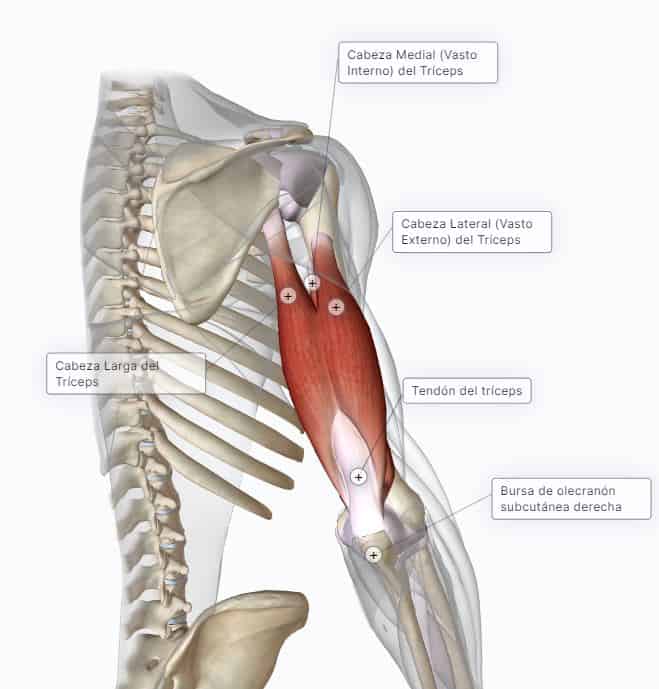
It is the main extensor. It occupies the posterior compartment of the arm. It has three heads at its origin: the longest arises from the scapula and the other two (medial and lateral) arise from the humerus.
Like the biceps muscle, its attachments extend beyond the two joints, and it acts on both the elbow joint and the shoulder joint.
- Long head: arises from the infraglenoid tubercle of the scapula and from here descends along the posterior surface of the arm, twisting on itself, crossing the omohumeral space and dividing it into two parts: a lateral one called the humero-teres-tricipital quadrangle (through which the axillary nerve and the posterior axillary vessels pass) and another called the omo-tricipital triangle (through which the scapular branch of the inferior scapular artery passes). This part descends to the common tendon of insertion.
- Lateral head (vastus lateralis): arises from the posterior surface of the humerus, above and lateral to the groove for the radial nerve. Its muscle fibres descend downwards and towards the midline, bridging the radial groove and turning it into an osteomuscular canal through which the radial nerve and the deep brachial artery pass.
- Medial head (vastus medialis): arises from the posterior surface of the humerus, below and medial to the torsion canal of the humerus (radial groove) and from the lower half of the medial and lateral intermuscular septa. It is deep. From these attachments the intermuscular septa converge towards the midline.
The three parts merge into a broad, flattened tendon that inserts on the superior surface of the olecranon and on the deep fascia of the forearm on either side of it. The triceps tendon has associated olecranon serous bursae (subcutaneous olecranon bursa and intratendinous and subtendinous olecranon bursa).
- Action: it is a powerful extensor of the elbow. Its long head also acts on the shoulder joint, assisting in adduction and extension of the arm.
Topographic importance of triceps brachii
- Omo-tricipital triangle: lies between the lateral border of the scapula medially, the long head of triceps laterally, and teres major inferiorly.
- Humero-teres-tricipital quadrangle or humerotricipital space: lies between teres major and teres minor, the humerus laterally and the long head of triceps medially.
- Humerotricipital cleft: lies between the humerus and the long head of triceps, and it is through here that the radial nerve passes from the axilla to the posterior compartment of the arm.
2.2 Anconeus
A small, triangular muscle on the dorsal aspect of the elbow joint, whose fibres merge with those of the triceps.
It arises from the lateral epicondyle of the humerus and from the dorsal part of the joint capsule, and from there its fibres run to the posterior part of the ulna, partly covering the annular ligament of the radius. It inserts on the lower part of the olecranon, on its lateral border.
- Action: when it contracts it produces extension of the elbow joint and assists in pronation. It is sometimes said to be a tensor of the joint capsule.
