In this lesson we will study the characteristics of the muscles of the foot. The foot is the region of the lower limb beyond the ankle joint. The toes can perform flexion and extension, adduction and abduction, and inversion and eversion.
The muscles of the foot have lost functionality compared with those of the hand; many are vestigial muscles, which may be atrophied or absent.
Remember that this lesson is part of the free courses from Paradigmia. Access the full course below 👇👇 MUSCULOSKELETAL SYSTEM COURSE
- Extensor muscles of the toes
- 1. Extensor hallucis longus
- 2. Common extensor of the big toe
- 3. Extensor digitorum brevis (pedius)
- 4. Extensor hallucis brevis
- Flexor muscles of the toes
- 1. Flexor digitorum longus
- 2. Flexor hallucis longus
- 3. Flexor digitorum brevis
- 4. Flexor hallucis brevis
- 5. Lumbricals
- 6. Quadratus plantae (Sylvius’s fleshy square muscle)
- Adductor muscles of the toes
- 1-Plantar interossei
- 2-Dorsal interossei
- Abductor muscles of the toes
- 1-Dorsal interossei
- Invertor muscles of the foot
- 1. Tibialis posterior
- 2. Tibialis anterior
- Evertor muscles of the foot
- 1. Fibularis longus or peroneus longus
- 2. Fibularis brevis or peroneus brevis
- 3. Extensor digitorum longus (common extensor of the toes)
- Recommended reading:
Extensor muscles of the toes
The extensor muscles of the foot region have the function of pulling the toes upwards. They are extensor hallucis longus, extensor digitorum longus, extensor digitorum brevis (pedius) and the lumbricals.

1. Extensor hallucis longus
2. Common extensor of the big toe
3. Extensor digitorum brevis (pedius)
It arises on the dorsum of the foot, by an extensive attachment to the talus, calcaneus and cuneiforms, runs forwards and gives off 3 tendons to insert on the base of the middle phalanges of the 2nd, 3rd and 4th toes.
4. Extensor hallucis brevis
It is like another fascicle of extensor digitorum brevis, whose tendon inserts on the base of the first (proximal) phalanx of the big toe.

Remember that this lesson is part of the free courses from Paradigmia. Access the full course below 👇👇 MUSCULOSKELETAL SYSTEM COURSE
Flexor muscles of the toes
These muscles pull the toes downwards, so they are found in the sole of the foot. They are flexor digitorum longus, flexor hallucis longus, flexor digitorum brevis, flexor hallucis brevis, the lumbricals and quadratus plantae.
On the sole of the foot lies the plantar aponeurosis, which varies in thickness from person to person; beneath it are the flexor muscles of the toes, the most superficial being flexor digitorum brevis.
1. Flexor digitorum longus
2. Flexor hallucis longus

3. Flexor digitorum brevis
It is the most superficial. It arises from the calcaneal tuberosity and runs forwards in the sole of the foot, giving off tendons that insert on the 2nd (middle) phalanx of the last 4 toes, leaving a gap at their insertion through which the insertion tendon of flexor digitorum longus passes.
4. Flexor hallucis brevis
It has two fascicles that insert on the sesamoid bones at the base of the 1st metatarsal, between which the tendon of flexor hallucis longus passes.
5. Lumbricals
They resemble earthworms. They are small, elongated muscles found in the sole of the foot, arising from the sides of the insertion tendons of flexor digitorum longus and inserting on the base of the proximal phalanges of the 2nd, 3rd and 4th toes.
Their function is practically negligible; they flex the first phalanx and extend the others.

6. Quadratus plantae (Sylvius’s fleshy square muscle)
It attaches to the lower part of the calcaneus and runs forwards to insert on the tendon of flexor digitorum longus. Quadratus plantae acts as a buttress so that the toes are not pulled towards the medial side when flexor digitorum longus contracts.
Since flexor digitorum longus acts as an evertor, quadratus plantae (which reaches the tendon) counteracts this movement. It is a neutralising muscle.

Remember that this lesson is part of the free courses from Paradigmia. Access the full course below 👇👇 MUSCULOSKELETAL SYSTEM COURSE
Adductor muscles of the toes
1-Plantar interossei
They are found in the plantar region between the metatarsals; there are three muscles that insert on the medial surface of the 3rd, 4th and 5th metatarsals and from there go to the medial surface of the base of the proximal phalanx of the same toes (3rd, 4th and 5th). They draw the toes towards an axis that passes through the 2nd metatarsal.
2-Dorsal interossei
There are four; they are found in the plantar region between the metatarsals. They arise between the two metatarsals they lie between (there are 4 spaces) and are arranged so that the 1st inserts on the medial border of the shaft of the proximal phalanx of the 2nd toe, and the remaining 3 dorsal interossei insert on the lateral border of the shaft of the proximal phalanx of the 2nd to 4th toes, so that the 2nd toe has one dorsal interosseous inserted on each side. They fan the toes apart about an axis that passes through the 2nd metatarsal.

Abductor muscles of the toes
1-Dorsal interossei
There are four; they are found in the plantar region between the metatarsals. They arise between the two metatarsals they lie between (there are 4 spaces) and are arranged so that the 1st inserts on the medial border of the shaft of the proximal phalanx of the 2nd toe, and the remaining 3 dorsal interossei insert on the lateral border of the shaft of the proximal phalanx of the 2nd to 4th toes, so that the 2nd toe has one dorsal interosseous inserted on each side.
They fan the toes apart about an axis that passes through the 2nd metatarsal.
Remember that this lesson is part of the free courses from Paradigmia. Access the full course below 👇👇 MUSCULOSKELETAL SYSTEM COURSE
Invertor muscles of the foot
These muscles are responsible for turning the sole of the foot inwards. They are tibialis anterior and tibialis posterior.
1. Tibialis posterior
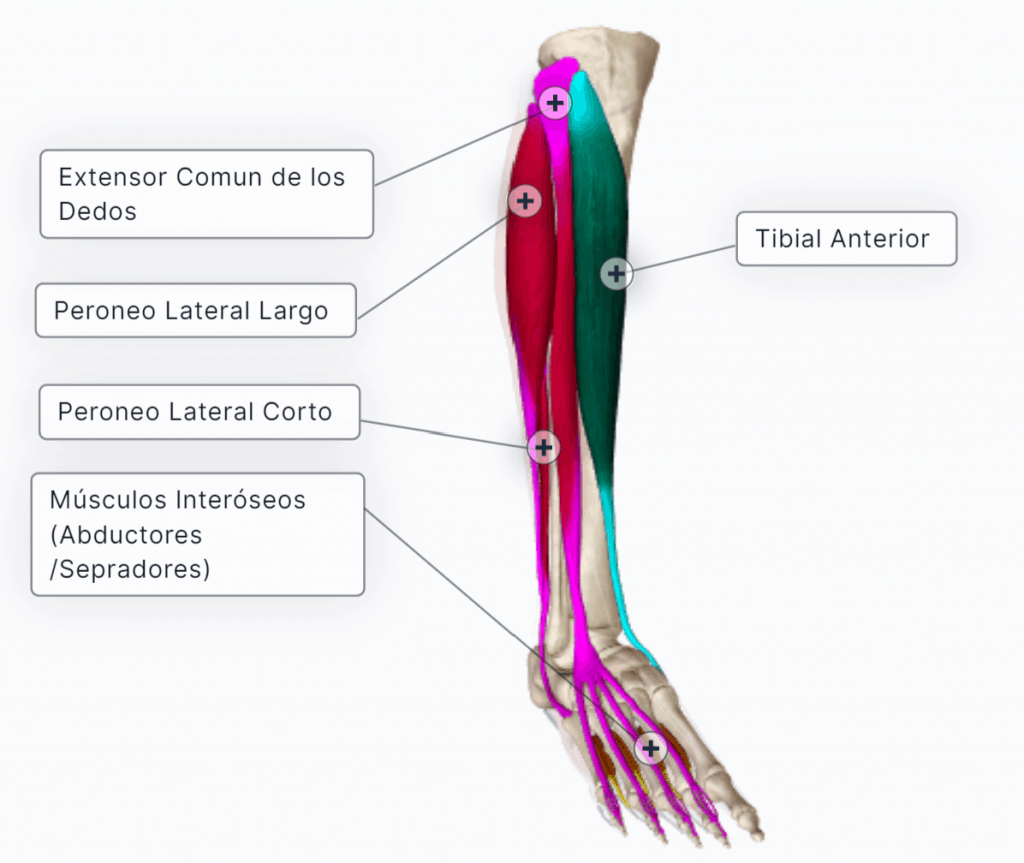
2. Tibialis anterior

Evertor muscles of the foot
They turn the sole of the foot outwards, so they are muscles found on the lateral side of the leg. They are fibularis longus, fibularis brevis and extensor digitorum longus.
1. Fibularis longus or peroneus longus
2. Fibularis brevis or peroneus brevis
3. Extensor digitorum longus (common extensor of the toes)

Remember that this lesson is part of the free courses from Paradigmia. Access the full course below 👇👇 MUSCULOSKELETAL SYSTEM COURSE