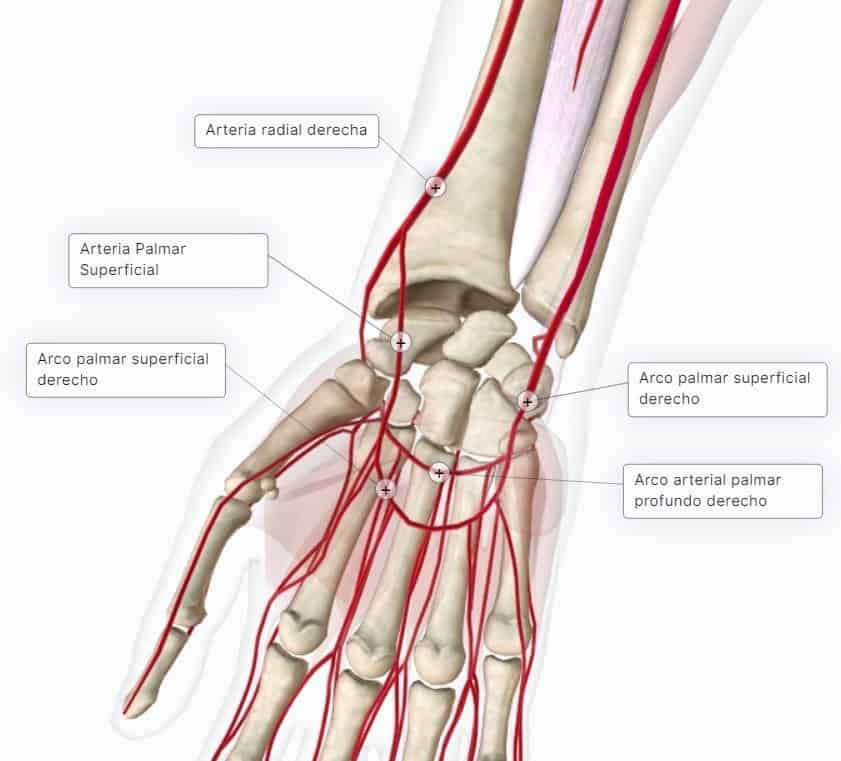
It is the lateral branch of the bifurcation of the brachial artery. It extends from the cubital fossa to the palm of the hand, passing successively along the anterior aspect of the forearm and the dorsal aspect of the wrist.
It descends laterally towards brachioradialis, which is its satellite muscle. It continues along the anterior aspect of the forearm, in an almost straight course, as far as the "pulse groove".
It then winds round the lateral side of the wrist joint, past the styloid process, and reaches the dorsal aspect of the carpus, crossing the "anatomical snuffbox" to pass deeply into the first interosseous space between the two heads of adductor pollicis. It emerges in the palm of the hand, where it joins the deep palmar artery (a branch of the ulnar artery) and forms the deep palmar arch.

1. Collateral branches
1.1 Radial recurrent artery
It arises at the elbow and anastomoses with the deep brachial artery.
1.2 Superficial palmar artery
It originates when the radial artery is leaving the pulse groove. It passes over the flexor retinaculum and pierces the short adductor of the thumb, supplying the muscles of the thenar eminence.
It then runs to the medial border of the hand, where it anastomoses with the ulnar artery, forming the superficial palmar arch.