Arteries
The vessels that run along the wall of the trunk arise from two trunks.
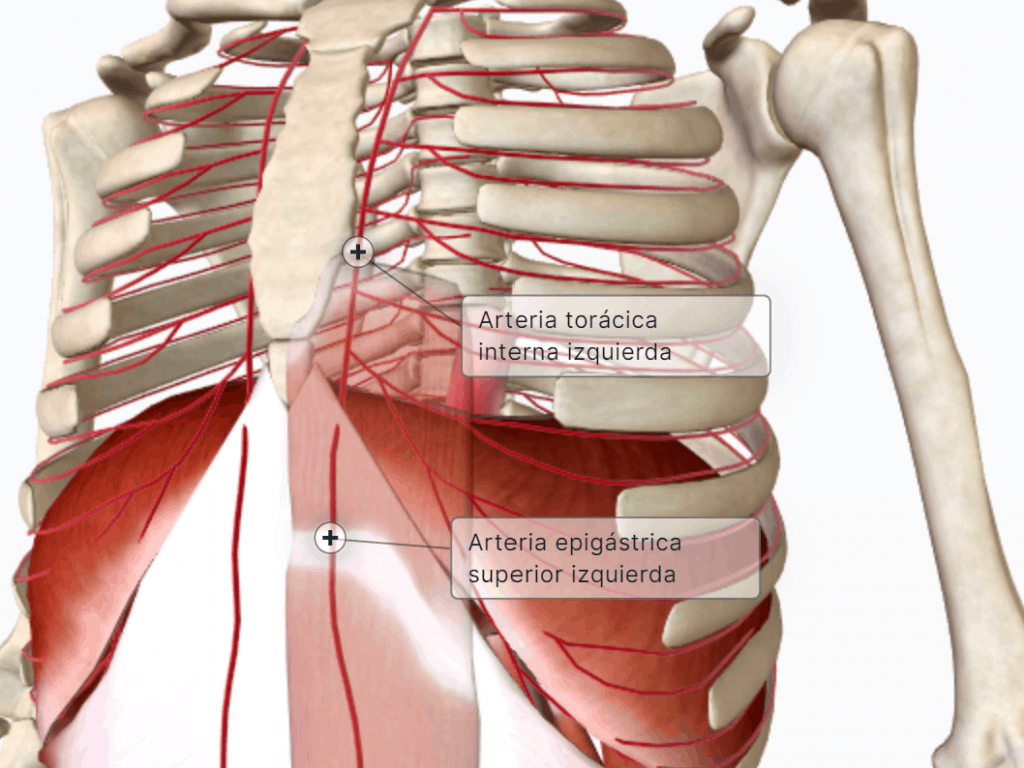
From the upper part arises the internal thoracic artery, a branch of the subclavian. It descends lateral to the sternum behind the costal cartilages. When this artery leaves the diaphragm it is called the superior epigastric artery.
In the lower part is the external iliac artery, which passes beneath the inguinal ligament to reach the crural region (thigh). Before this it gives off the inferior epigastric artery, which lies against the posterior surface of the recti. Both arteries, superior and inferior epigastric, run along the posterior surface of the recti and anastomose in the middle, forming a plexus.
The intercostal arteries of the lower ribs continue into the abdomen, supplying the lateral area.

Venous return
They follow practically the same course as the arteries. The superior epigastric vein drains into the internal thoracic vein, and the inferior epigastric vein drains into the external iliac vein, collecting blood from the anterior part of the abdomen.
Blood from the posterior and lateral parts is collected by the lumbar veins, which converge on the sides of the vertebral column into the lumbar venous trunks, which go on to form the azygos vein and the accessory (inferior) hemiazygos vein (azygos system)
In the subcutaneous cellular space there are some veins: the superficial epigastric vein and the thoracoepigastric vein, which connect the axillary vein with the femoral vein. This is a site of portocaval anastomosis; they can become varicose veins in the abdominal and costal walls when the normal territories are obstructed.
