In this lesson we will study the joints of the foot proper. These joints are the intertarsal, tarsometatarsal, intermetatarsal, metatarsophalangeal and interphalangeal joints. We will look at their anatomy, function and mobility.
Remember that this lesson is part of the free courses from Paradigmia. Access the full course below 🔹MUSCULOSKELETAL SYSTEM COURSE🔹
- Intertarsal joints
- Tarsometatarsal joints
- Intermetatarsal joints
- Metatarsophalangeal joints
- Interphalangeal joints
- Recommended reading
We have already looked at the ankle joints in previous lessons. The remaining intertarsal, tarsometatarsal, intermetatarsal, metatarsophalangeal and interphalangeal joints do not have much mobility, but they are important for the elasticity of the foot, in spreading the pressure exerted by body weight.
Intertarsal joints
These joints are named after the bones they join. Because they lie between the bones of the tarsus, they are known as the intertarsal joints.
The ligaments of these joints are short and lie between the articular surfaces (interosseous ligaments), on the dorsum of the foot (dorsal ligaments) and on the sole of the foot (plantar ligaments). They are plane joints.
- Cuneonavicular joint: between the navicular and the 3 cuneiform bones.
- Cuboideonavicular joint: between the navicular and the cuboid.
- Cuneocuboid joint: between the lateral cuneiform bone and the cuboid.
- Intercuneiform joints: these are the joints formed between the cuneiform bones.
Tarsometatarsal joints
The tarsometatarsal joints are formed between the metatarsals and the adjacent bones of the tarsus. They are plane synovial joints, with dorsal, plantar and interosseous ligaments.


Intermetatarsal joints
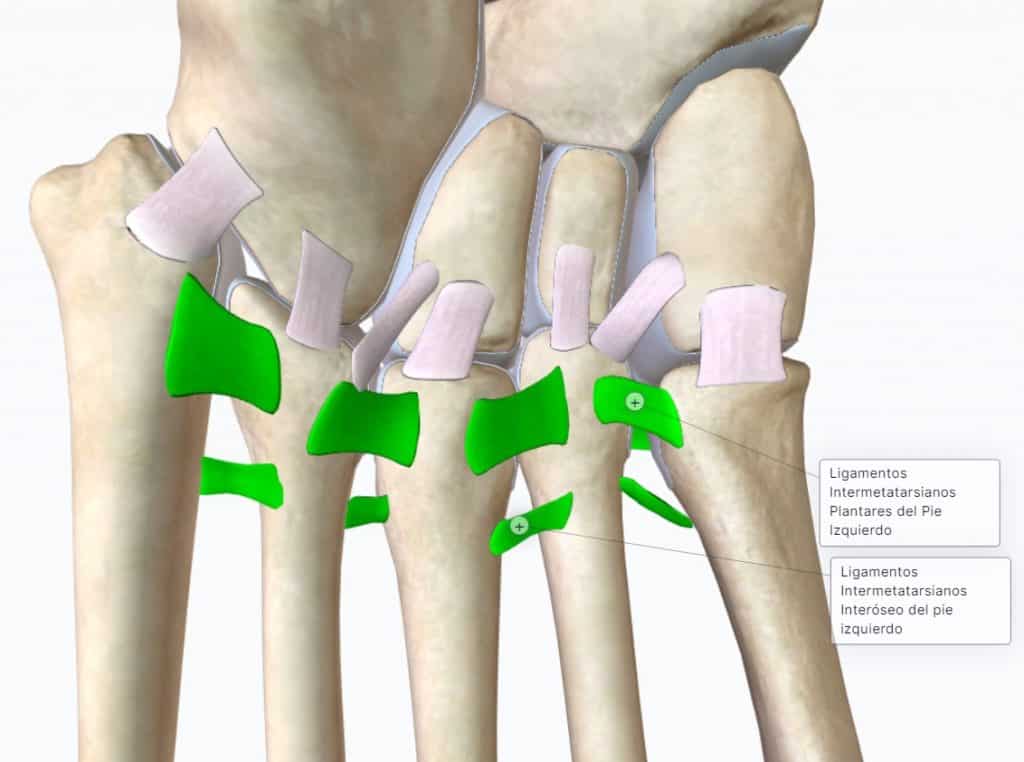
The intermetatarsal joints are the joints formed between the bases of the metatarsals. They are plane joints. They have dorsal, plantar and interosseous ligaments.
Remember that this lesson is part of the free courses from Paradigmia. Access the full course below 🔹MUSCULOSKELETAL SYSTEM COURSE🔹
Metatarsophalangeal joints
The metatarsophalangeal joints are formed between the heads of the metatarsals and the bases of the phalanges. They are condyloid joints, which carry out flexion and extension, and adduction and abduction.
They have medial and lateral collateral ligaments, plantar ligaments and the deep transverse metatarsal ligament: it joins the heads of the metatarsals on the plantar surface.

Interphalangeal joints
These interphalangeal joints are the proximal and distal joints between the phalanges. They are hinge joints and carry out flexion and extension. They are reinforced by the collateral and plantar ligaments.

Remember that this lesson is part of the free courses from Paradigmia. Access the full course below 🔹MUSCULOSKELETAL SYSTEM COURSE🔹