The complement system has three activation pathways: classical, lectin and alternative. Its function is to destroy the tissues in which pathogens settle, through direct lysis, facilitation of phagocytosis by opsonisation and the recruitment of inflammatory cells to the site of infection (anaphylatoxins).
The complement system is activated by the presence of pathogens but can be dangerous because it could destroy the body’s own cells and systems. Precise regulation is therefore necessary, by means of membrane-bound and soluble molecules that block or prevent its action.
This regulation has become better understood in recent years, and knowing about it is very important because it explains some immunodeficiencies in which some of the regulatory molecules are missing, so that complement remains constantly active and tissue destruction occurs.
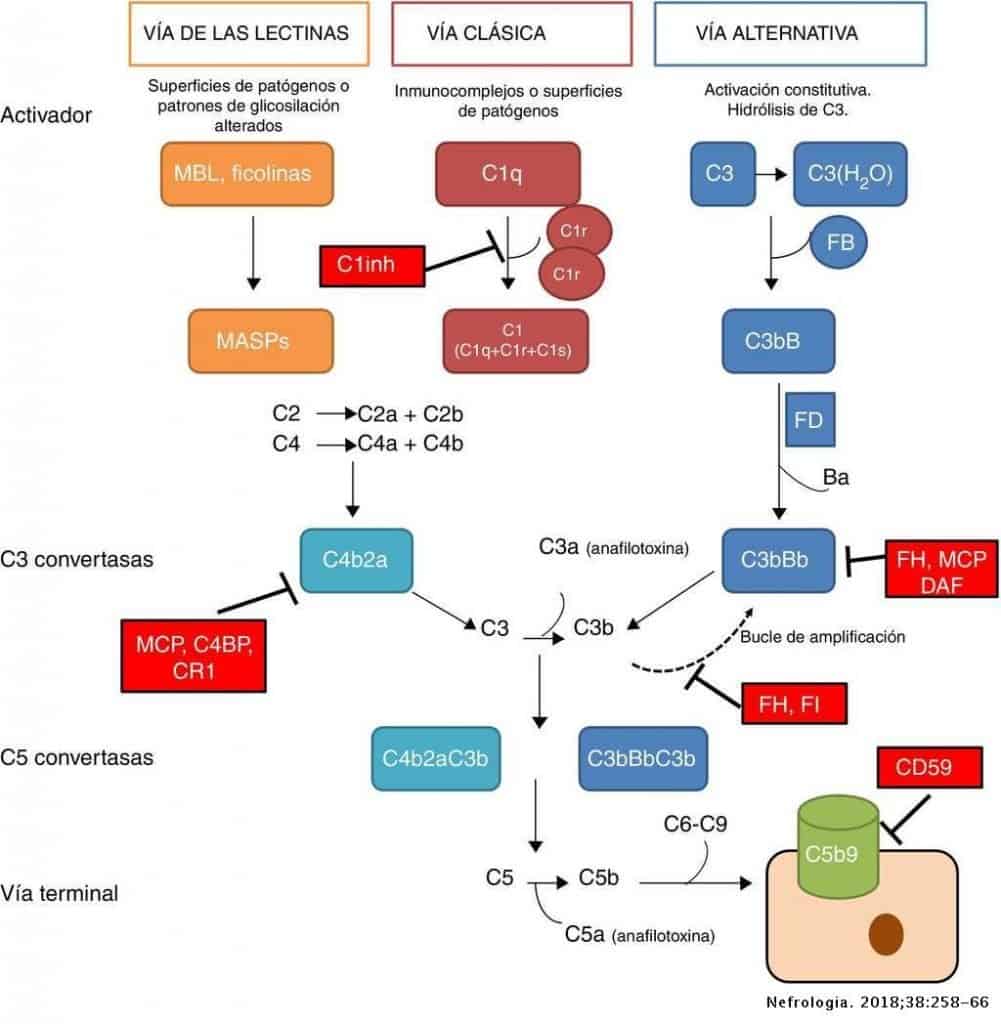
The following image shows a schematic of the activation of the complement system by the three pathways:
The destructive capacity of the complement system is regulated to prevent spontaneous activation and tissue damage. In addition to their relative instability (short half-life), mammals have soluble or membrane-bound regulatory proteins that inactivate or destroy complement components.
Classical and lectin pathways
The classical pathway belongs to adaptive immunity. It is activated by the presence of specific antibodies bound to a pathogen. The antigen is recognised by the C1 factor, which triggers the whole process.
The lectin pathway belongs to innate immunity. It is activated in the presence of certain structures on the surface of pathogens, which are recognised by LBP or by the ficolins.
The alternative pathway belongs to innate immunity and does not require Ab. Complement is activated simply by the presence of pathogen proteins (lipopolysaccharide…). The C3 factor is activated and then triggers the rest of the factors.
These three pathways converge in a common step, the formation of C3 convertase (an amplifying mechanism). From it the other factors are formed: C5 convertase, C5, C6, C7, C8 and polyC9, which lead to the formation of the MAC that destroys the pathogen (if the MAC were activated in other situations, the host cell would be destroyed).
Regulatory molecules
There are a number of regulatory molecules that act at three different points:
- Before the formation of C3 convertase: they prevent the convertase from forming.
- Destruction of C3 convertase: once it has formed.
- Preventing the formation of the MAC or preventing it from attaching to the cell membrane.
Bear in mind that complement molecules are very unstable (short half-life), so complement regulation has to be controlled very tightly.
Under normal conditions there are molecules, the complement receptors, which are expressed on the membrane of cells of the immune system and have a clearing role (clearance of all the material).
On the other hand, the regulatory molecules prevent complement from being activated nearby or from attacking one of the body’s own cells. There is one exception, the molecule CR1 (CD35), which has both functions.