Function of adhesion molecules
Adhesion molecules take part in leucocyte trafficking and in the maturation, activation and effector function of leucocytes, a process that takes place in 4 stages (direction of the blood from left… to right):
1. ROLLING or CAPTURE OF THE LEUCOCYTE: allows activation of the cells by contact.
We start with a leucocyte with inactive integrins that constitutively expresses certain selectins (in this case R), which will make contact with one of the ligands in the absence of inflammation. This first contact is essential because the proteins are attracted to the wall; these cells stumble and slow down, favouring interactions with the cells of the vessels or endothelium. All these contacts with the endothelium in turn favour the activation of the integrins.
2. FIRM ADHESION: always begins with the expression of integrins, which are expressed not only on the vessels but also in the extracellular matrix. Activation of the leucocyte by chemoattractants starts intracellular signalling cascades that induce the activation of leucocyte integrins, changing their inactive conformational state to a state of high affinity for their ligands expressed on the surface of the vascular endothelium. This allows firm adhesion of the leucocyte to the endothelium, which is maintained mainly by the interaction between the integrin LFA-1 and its ligand ICAM-1 and between the integrin VLA-4 and its ligand VCAM-1.
3. MIGRATION ACROSS THE ENDOTHELIUM: this occurs constantly and follows a chemotactic gradient. The bonds between integrins and their ligands are continually formed and broken, favouring this movement.
4. DIAPEDESIS: the leucocyte finally migrates between the lateral contacts of the endothelial cells, escaping from the bloodstream and passing into the lamina propria.
Finally, a series of cytokines are released that attract the rest of the molecules to the inflammatory focus. These 4 stages occur both in physiological processes and in inflammatory processes, although with some small differences

Image taken from the slides provided by Professor Arranz, Faculty of Medicine, Valladolid, Topic 13, Immunology, academic year 2014-15.
-PHYSIOLOGICAL SELECTIVE MIGRATION (DRAWING): a cell passes into a secondary lymphoid organ before its activation. (NORMAL PROCESS OF RECIRCULATION OF THESE CELLS) (from right to left, the different stages: In this case L-selectin is the initial contact element, followed by the process of leucocyte adhesion that we have just described. The initial rolling phases of lymphocytes on the endothelium are carried out by interactions between L-selectin and its ligands; they act with the addressins GlyCAM-1 or MAdCAM-1 present on the venules of the high endothelium. The phase of firm adhesion of the leucocyte to the vascular endothelium is started by the action of chemokines such as CCL21 or CCL19, which are constitutively displayed on the surface of the vascular endothelium, and their receptor CCR7, which activates LFA-1, allowing firm adhesion to the endothelium, migration and diapedesis.
-IN AN INFLAMMATORY PROCESS: we have INDUCED expression; the stages are the same but the molecules are somewhat different (THE EXPRESSION OF THE INITIAL SELECTINS CHANGES: here we will find at the outset a large number of molecules that mediate inflammation and fight infection (macrophages, mast cells, complement…)
Here L-selectin is not so involved, but rather PSGL-1 (in the case of local inflammation). In this case the ligand is the P-selectin expressed by the vessels. The initial stimuli and the initial selectins are what determine the difference between the two processes: physiological recirculation or recirculation INDUCED by inflammation.
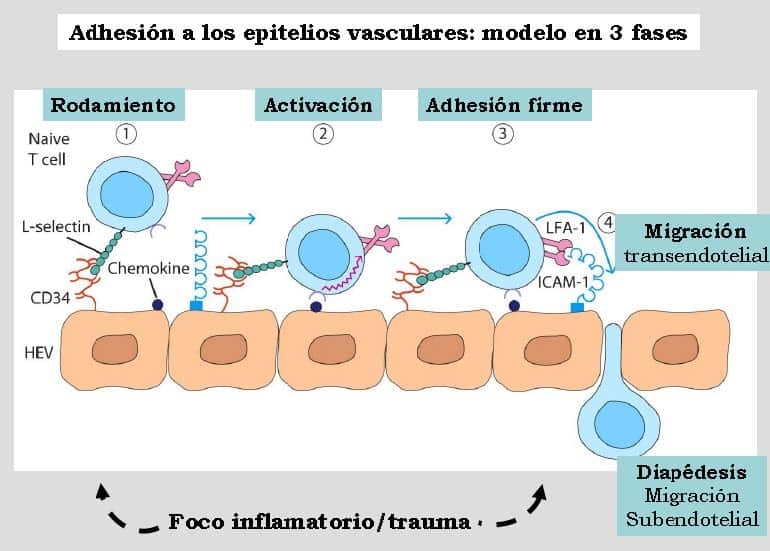
Image taken from the slides provided by Professor Arranz, Faculty of Medicine, Valladolid, Topic 13, Immunology, academic year 2014-15.

Image taken from the slides provided by Professor Arranz, Faculty of Medicine, Valladolid, Topic 13, Immunology, academic year 2014-15
EXAMPLES OF SOME CELLS IN DIFFERENT SITUATIONS:
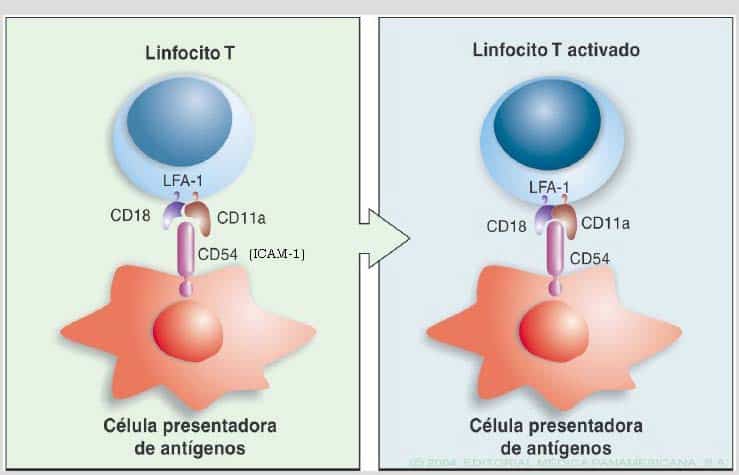
Image taken from the slides provided by Professor Arranz, Faculty of Medicine, Valladolid, Topic 13, Immunology, academic year 2014-15
-Selective migration of leucocytes: extravasation profiles of a neutrophil towards an inflammatory focus; and of an immature T lymphocyte across the vascular endothelium of a secondary lymphoid tissue (recirculation to a lymph node)
-Activation of T lymphocytes and avidity of adhesion molecules for their ligands (the affinity of these molecules increases after activation) (ICAM-1): Integrins and adhesion molecules of the immunoglobulin family are involved in the process of T lymphocyte activation, helping to stabilise the cellular interaction by two mechanisms:
- 1) induction of new and/or more adhesion molecules
- 2) increased affinity of integrins for their ligands.
Without this interaction the T lymphocyte is not activated.
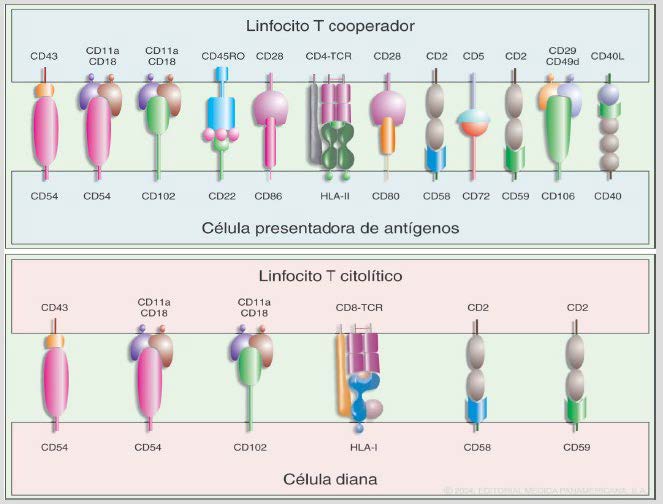
-Accessory molecules of the TCRαβ complex expressed on the membrane by the 2 main types of resting T lymphocyte (CD4+ helper, CD8+ cytolytic)
LFA-1 continues to appear as an important molecule without which the function could not be carried out.

Image taken from the slides provided by Professor Arranz, Faculty of Medicine, Valladolid, Topic 13, Immunology, academic year 2014-15
-Selective migration of effector T lymphocytes: extravasation profiles across the vascular endothelium of the mucosa-associated lymphoid tissue of the intestine, and of the skin
In the case of the skin, thanks to the molecules expressed, the CELL COULD RETURN TO THE SITE WHERE IT WAS ACTIVATED (the intestine) but not to another tissue, because it does not have E-selectin.
From this we conclude that, thanks to all this, we could know where they come from and where they are going.
Regueiro J.R., López C., González S. & Martínez E. (2011) Inmunología. Biología y Patología del Sistema Inmune. (4th Ed.) Editorial Médica Panamericana,

Image taken from the slides provided by Professor Arranz, Faculty of Medicine, Valladolid, Topic 13, Immunology, academic year 2014-15
Effector function: mechanisms of cell lysis mediated by effector Tc cells