Adhesion molecules: structure and families
Adhesion molecules are membrane glycoproteins expressed on the surface of leucocytes and endothelial cells, allowing these cells to interact with one another (leucocyte-endothelium, lymphocyte-APC) and with the extracellular matrix.
They are involved in leucocyte trafficking (selective migration) and cell activation. (Leucocyte trafficking is selective migration (cells leave according to these adhesion molecules and the receptors present in those tissues).
Antigen-presenting cells also bear adhesion molecules, as well as other molecules that they use to activate lymphocytes.

Regueiro J.R., López C., González S. & Martínez E. (2011) Inmunología. Biología y Patología del Sistema Inmune. (4th Ed.) Editorial Médica Panamericana, Madrid.
Some therapies used in chronic inflammatory diseases: the cell is kept recirculating until it dies, without being allowed to reach the target tissue and therefore without being able to contribute to that inflammation
There are 4 major families of adhesion molecules, which include the ligands (adhesion molecules) and the receptors (those on which they act):
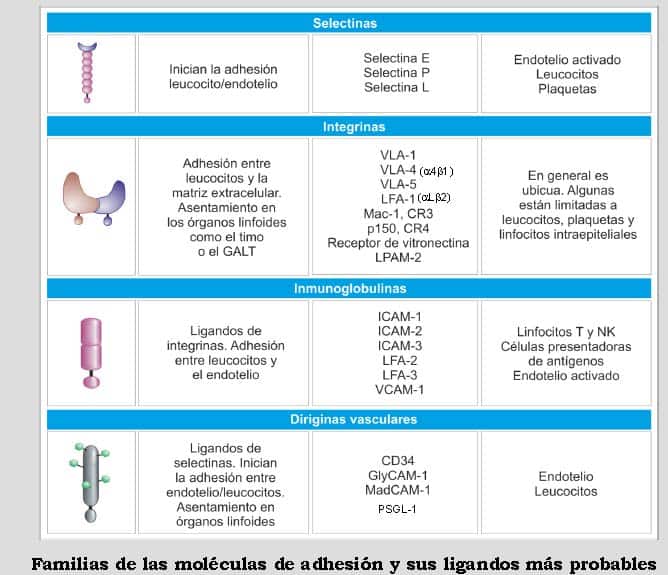
Regueiro J.R., López C., González S. & Martínez E. (2011) Inmunología. Biología y Patología del Sistema Inmune. (4th Ed.) Editorial Médica Panamericana, Madrid
A. THE SELECTINS
So called because they have an extracellular lectin-type domain. They play a fundamental role in the initial binding of leucocytes to the vascular endothelium. They interact through their lectin domain with the sugar portion of membrane glycoproteins, specifically with a fucosylated, sialylated tetrasaccharide called SIALYL LEWIS (sLeX). The interactions between selectins and their sugar ligands are weak and transient, forming and breaking quickly, so that leucocytes “stumble” and stick to the endothelial wall. (FIRST INTERACTION BETWEEN LEUCOCYTES AND VASCULAR ENDOTHELIUM)
They are found as cytoplasmic granules that appear on the vascular surface when the endothelium is activated (inflammation)
There are 3 types of selectin:
- P-selectin: expressed on platelets and by activated vascular endothelium.
- E-selectin: only when the vascular endothelium is activated by inflammation.
- L-selectin: expressed on leucocytes and activated naive T lymphocytes.
A.1 SELECTIN LIGANDS: MUCINS AND ADDRESSINS
The ligands of these selectins are the VASCULAR ADDRESSINS; among the different types, the following stands out:
- MUCIN: PSGL-1: expressed by leucocytes, it interacts with the selectins expressed on the endothelium: with E-selectin or P-selectin (endothelium)
Immature lymphocytes will express these molecules, and through these mechanisms these mature T lymphocytes from the bone marrow can head to other tissues (THYMUS…).
B) ADDRESSINS
- GlyCAM-1: ligand of the selectins expressed in peripheral tissues, such as lymph nodes.
- MAdCAM-1: ligand of the selectins for those lymphocytes that recirculate and settle in the venules of the intestinal endothelium (Peyer’s patches).
- CD34: expressed by the leucocytes that interact with vascular endothelial cells, which settle in secondary lymphoid tissue (lymph nodes) via L-selectin.
C) INTEGRINS
They are involved in the exit of these cells into the vessels and the different tissues.
They are a family of 24 heterodimeric receptors made up of an α chain (there are 18 different α chains) and a β chain (there are 8 β chains).
The most important are those that use the beta2 or beta1 chain, whatever the alpha chain. And above all, among the beta2-chain integrins, one stands out from the rest: LFA-1 (CD11a: name of the alpha chain/CD18: name given to the beta2 chain), which plays an important role in firm adhesion and in the migration of leucocytes across the vascular endothelium.
-LFA-1 is expressed only on lymphocytes. Its ligands are the IgCAM adhesion molecules
-Also prominent are the α4β7 integrins (very important in maintaining the integrity of the GI mucosa). The predominant integrin between lymphocytes and the GI mucosa or endothelial vessels.
-The α4β1 integrin (VLA-4) Very important in peripheral immunity as a representative of the alpha 1 integrins, which is also expressed on the vascular endothelium, and interacts with VCAM.
An important feature of integrins is that their activity can be modulated, switching from an inactive conformational state, in which the integrin is folded over on itself, to an active conformational state in which the substrate-binding sites are accessible. Integrins establish an interaction that will be decisive for the exit of cells into the tissues or the lymph nodes.
D) IgCAMs OR ADHESION MOLECULES OF THE IMMUNOGLOBULIN FAMILY
They form a group of proteins that possess at least one immunoglobulin-type domain. They often act as ligands of integrins, like the IgCAMs, called intercellular adhesion molecules:
-(ICAM-1, ICAM-2, ICAM-3) are the ligands of LFA-1. (they interact with beta2 integrins) And the vascular cell adhesion molecules (VCAMs), which are expressed on the endothelium of vessels and act as ligands of beta1 integrins.
MEMBERS OF THE INTEGRIN SUPERFAMILY:
- LFA-1 (Lymphocyte Function Associated Antigen)
- Different α and β subunits: beta1 (CD29) or VLAs; beta2 (CD18)
- Leucocyte integrins (always expressed by leucocytes)
MEMBERS OF THE IMMUNOGLOBULIN SUPERFAMILY
- ICAM-1 (Intercellular
- Adhesion Molecules): ligand of LFA-1
- ICAM-2, ICAM-3 (CD58) -VCAM, NCAM, PECAM
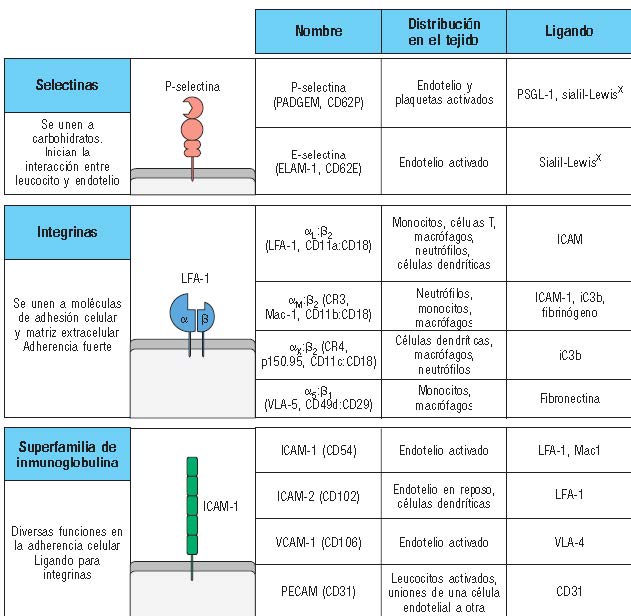
Murphy K., Travers P. & Walport M. (2008) Janeway’s Immunobiology (7th Ed.) Garland Science, New York.