Classification of cytokine receptors
Murphy K., Travers P. & Walport M. (2008) Janeway’s Immunobiology (7th Ed.) Garland Science, New York.
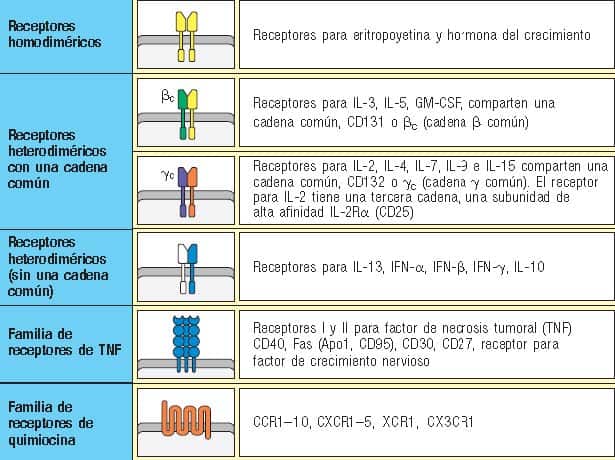
Each member of a family is a variant with a different specificity, which performs a particular function in the cell that expresses it:
- The haematopoietin receptor superfamily includes homodimeric and heterodimeric receptors, which are subdivided into families on the basis of protein sequence and subunit structure.
- The receptor for the macrophage cytokine IL-6 (chap. 2) is also a member of the haematopoietin superfamily, but it signals through an accessory chain other than βc or γc.
- The receptors for interferons and interferon-like cytokines are heterodimeric receptors that make up another, smaller family of cytokine receptors.
- The tumour necrosis factor receptor (TNFR) and the chemokine receptor family, the latter belonging to the very large superfamily of G protein-coupled receptors.
Many members of the IL-2 receptor subfamily (receptors for class I cytokines) share a signal-transducing γ chain (common gamma chain). The IL-2 and IL-15 receptors are heterotrimers in which the transducing chains are β and γ.
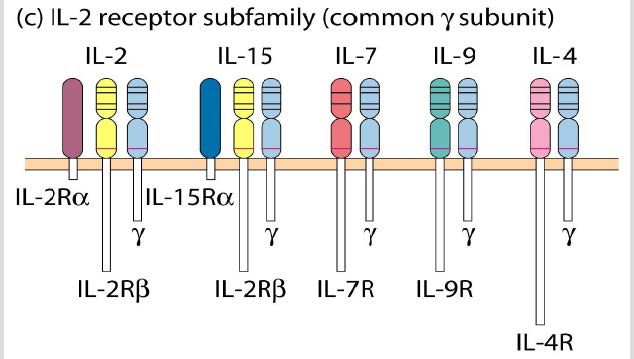
Image taken from the slides provided by Professor Arranz, Faculty of Medicine, Valladolid, Topic 13, Immunology, academic year 2014-15.
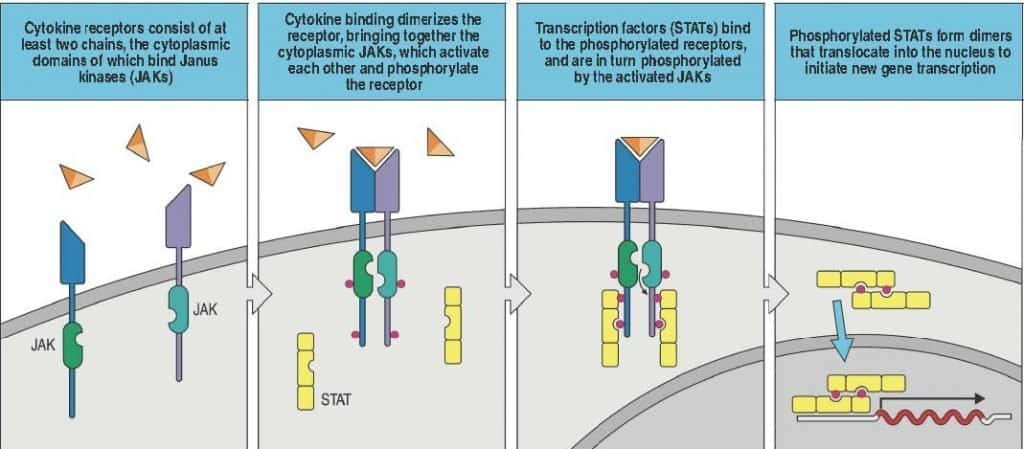
General model of signal transduction mediated by most class I and II cytokine receptors:
The cytokine is recognised by the receptor (in general, membrane receptors are dimers) and, on binding, dimerisation occurs, which leads to the activation of a cascade of kinases (JAK): CLASS I AND II RECEPTORS. This pathway also activates, and causes dimerisation of, a family of proteins (transcription factors) called STAT, which act in the nucleus on DNA, activating a specific set of genes and, consequently, protein synthesis
Murphy K., Travers P. & Walport M. (2008) Janeway’s Immunobiology (7th Ed.) Garland Science, New York.