Here is the syllabus explained in the video above. If you have any questions, post them in the comments section at the bottom of the page.
Mechanisms for amplifying the repertoire
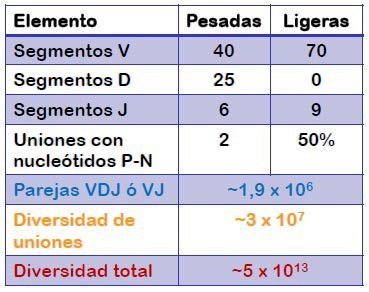
The diversity of immunoglobulins derives, on the one hand, from the variability of the light and heavy chains and, on the other, from the different ways in which these chains can pair with one another. This would give a potential immunoglobulin diversity of 4.5 million. However, our lymphocyte repertoire is known to reach the order of 1011 (Figure 8.10), so there are two additional mechanisms: junctional diversity and somatic hypermutation.
Junctional diversity
These mechanisms take place at the time of gene rearrangement, during B-cell maturation in the bone marrow. They arise because V-D-J somatic recombination (in heavy chains) or V-J recombination (in light chains) is not a high-precision mechanism. As a result, the cutting and splicing between the different fragments is not always the same, even when the same fragments take part. It constitutes a mechanism of diversity for several reasons:
- The inherent flexibility of the junctions (Figure 8.6): the point at which the DNA is cut in the 2 fragments can vary, producing alternative codons. In other words, the recombinase does not necessarily cut the fragments at the same point every time. Depending on the cut point, and on between which nucleotides the junction is made, the DNA reading frame can change and different amino acids can thus be introduced into the protein; however, not all junctions give rise to productive V-J or V-D-J rearrangements, since early termination codons can be introduced (Figure 8.7).
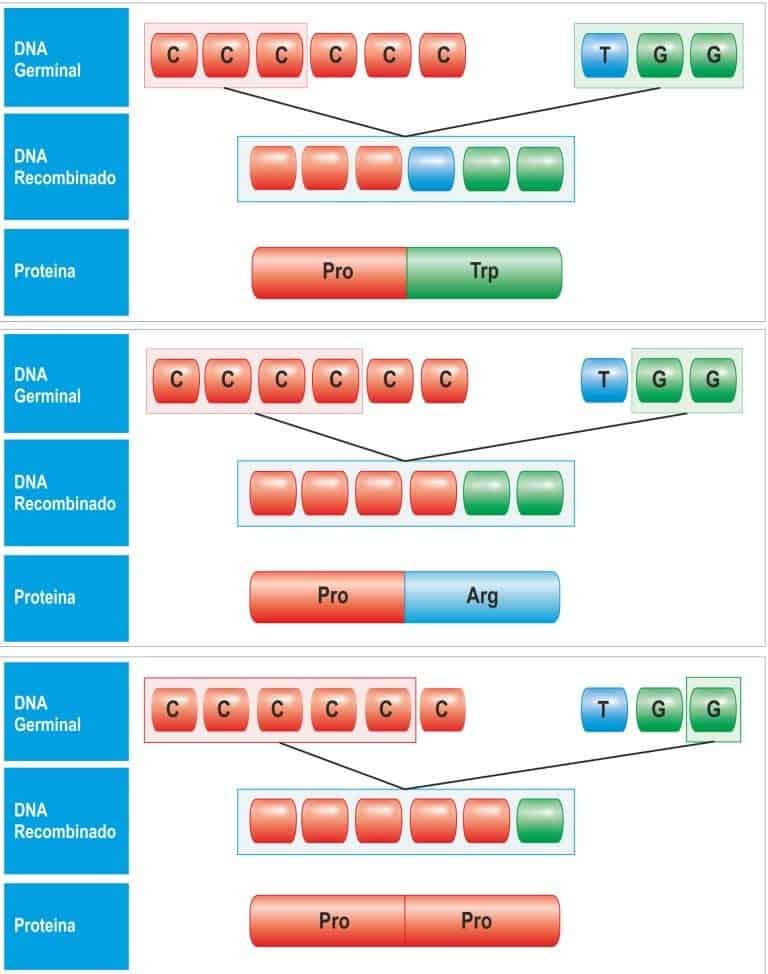
(Reproduced from Regueiro J.R., López C., González S. & Martínez E. (2011) Inmunología. Biología y Patología del Sistema Inmune. (4th Ed.) Editorial Médica Panamericana, Madrid.)
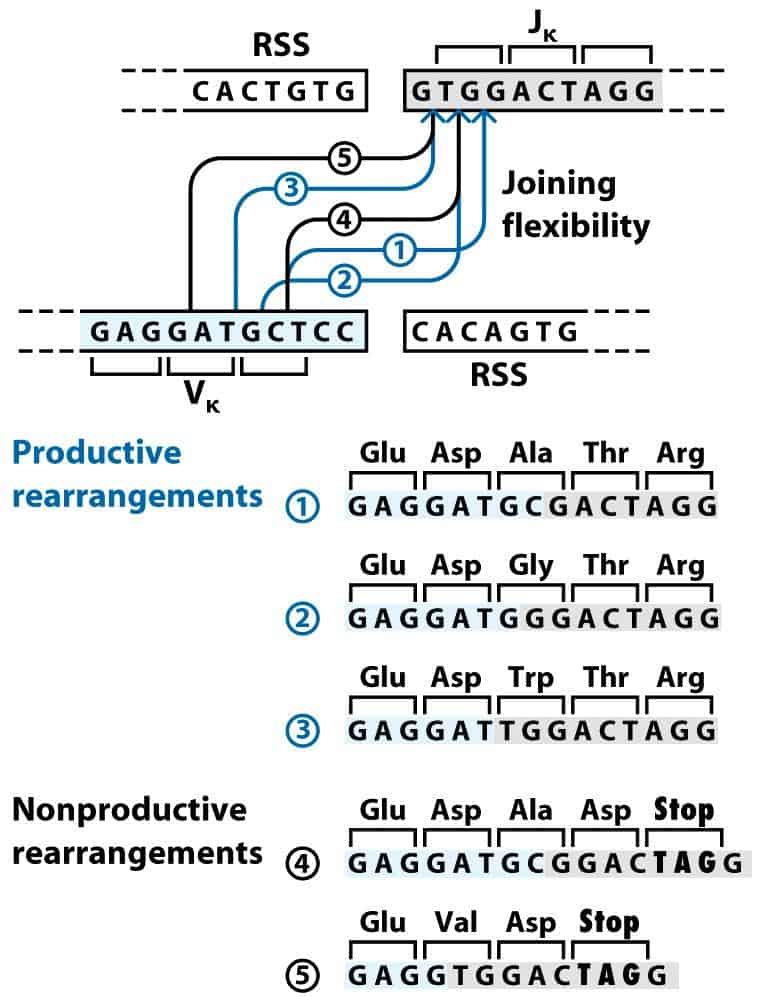
(Reproduced from Kindt T.J., Goldsby R.A., Osborne B.A. & Palacios R. (2007) Inmunología de Kuby (6th Ed.) McGraw-Hill Interamericana, Madrid.)
- The addition of extra nucleotides, which occurs through 2 different processes:
- The nucleotides carried along in the rearrangements, after cleavage of the single-stranded DNA, and left hanging at the end, fold back to form a hairpin structure (Figure 8.8-A) that protects the DNA. When this hairpin is opened, these nucleotides are left “hanging” and the action of repair enzymes adds the complementary nucleotides to this strand, generating a palindromic sequence, which is why these nucleotides are called P nucleotides. In this process P nucleotides are carried along at random in both light and heavy chains (and are responsible for a large increase in variability, but also for possible changes in the reading frame that would give rise to abortive proteins).
- In addition, the enzyme terminal deoxynucleotidyl transferase (TdT) can add a few nucleotides (in variable number) at random, without a template, at the junctions. (Figure 8.8-B). Their incorporation generates considerable diversity. These nucleotides are called N nucleotides. This random addition of nucleotides by TdT always occurs, and at 2 sites in the heavy chains (between the D and J fragments and between the V and D fragments). In the light chain, however, it occurs at a single site (between the V and J fragments) and only in 50% of cases. The length of N nucleotides has been observed to reach up to 15.
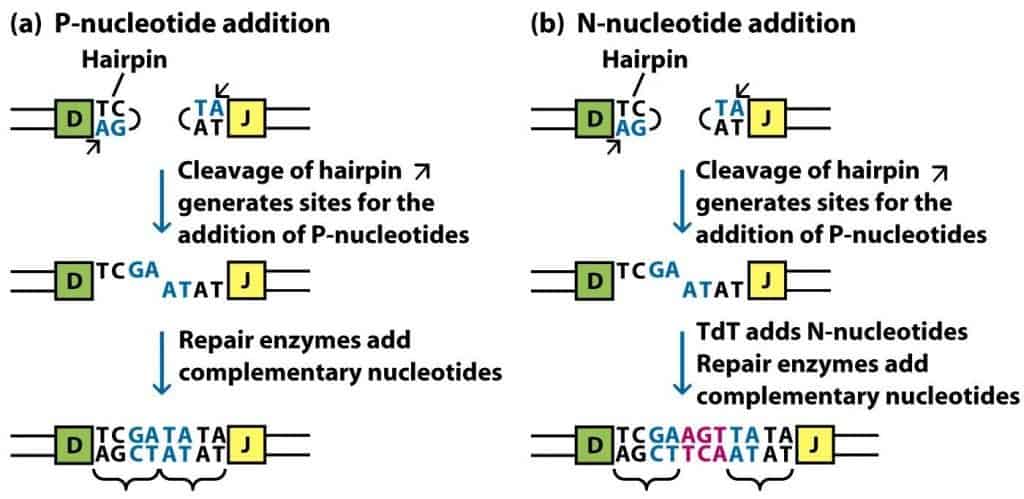
(Reproduced from Kindt T.J., Goldsby R.A., Osborne B.A. & Palacios R. (2007) Inmunología de Kuby (6th Ed.) McGraw-Hill Interamericana, Madrid.)
Somatic hypermutation
This variability-inducing mechanism acts in the secondary lymphoid organs, once a mature B cell has been activated in response to an antigen. Experiments have shown that when an antigen is introduced into a mouse, after a few days mutations appear in the variable regions of both heavy and light chains (Figure 8.9). Then, if there is secondary immunisation, many more mutations are observed in the variable regions. The point mutations introduced in this process may or may not alter the amino acid sequence of the variable region.
The changes that modify the protein sequence (productive mutations) are concentrated in the regions encoding the hypervariable regions (CDRs, which interact with the antigen), whereas those that do not modify the sequence (silent mutations) tend to occur in the flanking regions. This process occurs at random at the time the B cell responds to the antigen.
The result can be disastrous, giving rise to termination codons that generate truncated proteins, or encoding immunoglobulins that do not recognise the antigen. In these cases, the B cells do not progress.
However, it is also possible for the mutation to result in antibodies of higher affinity, which allow better recognition of the antigen. This is why this mechanism is also called affinity maturation. These clones will be selected, which allows the immune response to be refined.
This repertoire-amplification system is not included in the calculation of the different receptors that can be generated; nevertheless, it is one more mechanism for generating diversity.
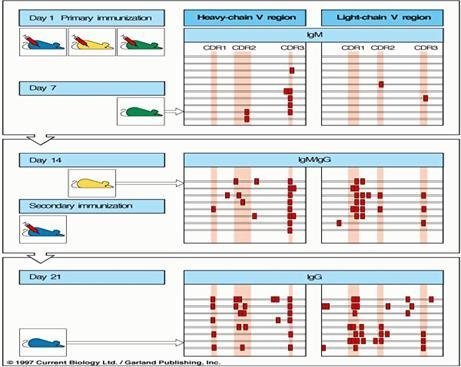
(Reproduced from Murphy K., Travers P. & Walport M. (2008) Janeway’s Immunobiology (7th Ed.) Garland Science, New York.)