Here is the syllabus explained in the video above. If you have any questions, post them in the comments section at the bottom of the page.
Expression of immunoglobulins in the BCR
Allelic exclusion
Allelic exclusion is the phenomenon whereby, after the synthesis of a functional or productive Ig, rearrangement stops (the recombinases halt and no further loops are formed). Each B cell thus has only one type of Ab on its surface or secreted. This specificity will be maintained throughout the life of the B cell (it could only undergo changes in affinity, through somatic hypermutation mechanisms). Allelic exclusion is therefore responsible for the monospecificity of Ag recognition by the B cell.
The mature B cell (which has already completed the gene rearrangement of its chains), in primary responses, can only synthesise IgM or IgD. This is for physical reasons (the mRNA reaches the Cμ and Cδ genes, which are the first in the sequence on chromosome 14). Whether this immunoglobulin is membrane-bound or soluble depends on whether RNA processing includes the exons that encode the transmembrane and cytoplasmic portion of the protein or, alternatively, the secretory portion (Figure 8.11).
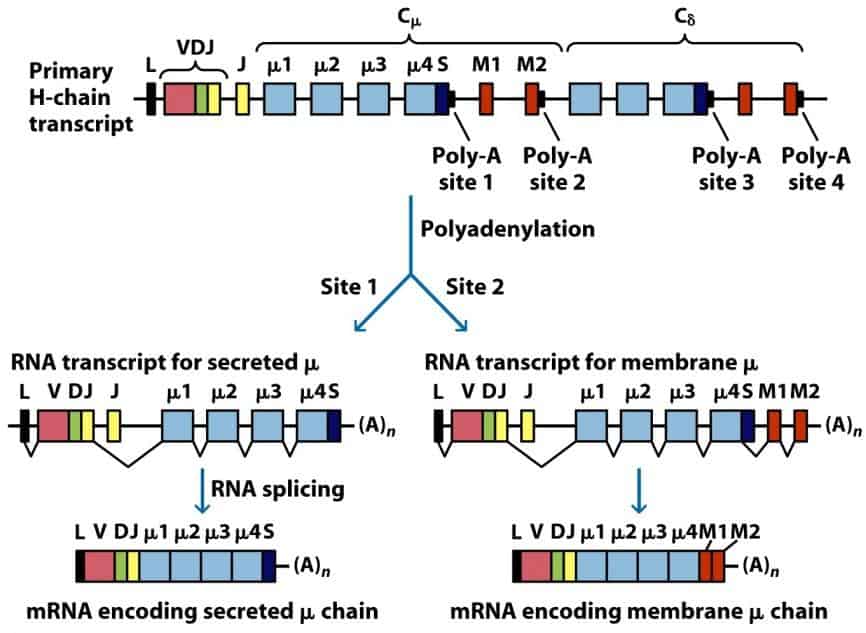
(Reproduced from Kindt T.J., Goldsby R.A., Osborne B.A. & Palacios R. (2007) Inmunología de Kuby (6th Ed.) McGraw-Hill Interamericana, Madrid.)
Whether the immunoglobulin is IgM or IgD also depends on this RNA processing (Figure 8.12). The other isotypes cannot be produced initially, as they require additional changes in the DNA. The immunoglobulins that a mature B cell can initially produce are therefore: mIgM, sIgM, mIgD, sIgD (where s and m indicate soluble or membrane-bound).
Isotype switching
To synthesise other isotypes, so-called isotype switching has to take place. Isotype switching occurs several times in a clonal line and does not involve the variable regions (whose rearrangement in the bone marrow is always retained, for example V1D3J9) but rather the constant-region genes (Figure 8.13). It is very common in B cells in the bone marrow.
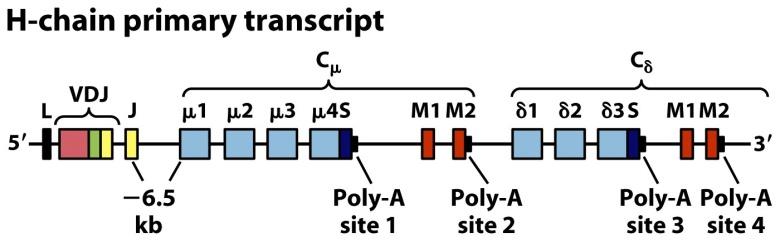
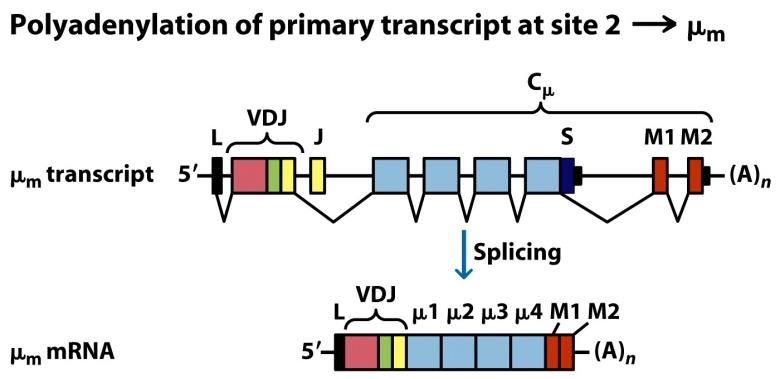
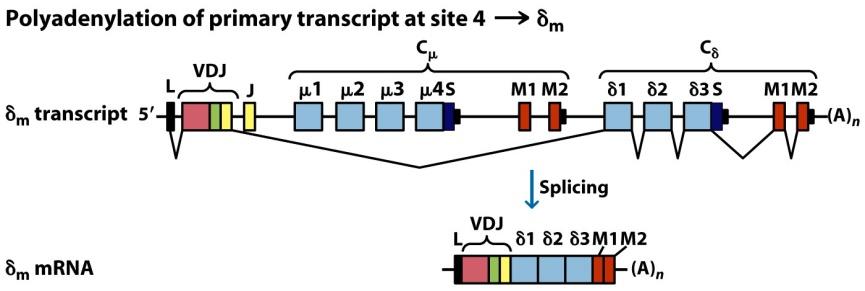
(Reproduced from Kindt T.J., Goldsby R.A., Osborne B.A. & Palacios R. (2007) Inmunología de Kuby (6th Ed.) McGraw-Hill Interamericana, Madrid.)
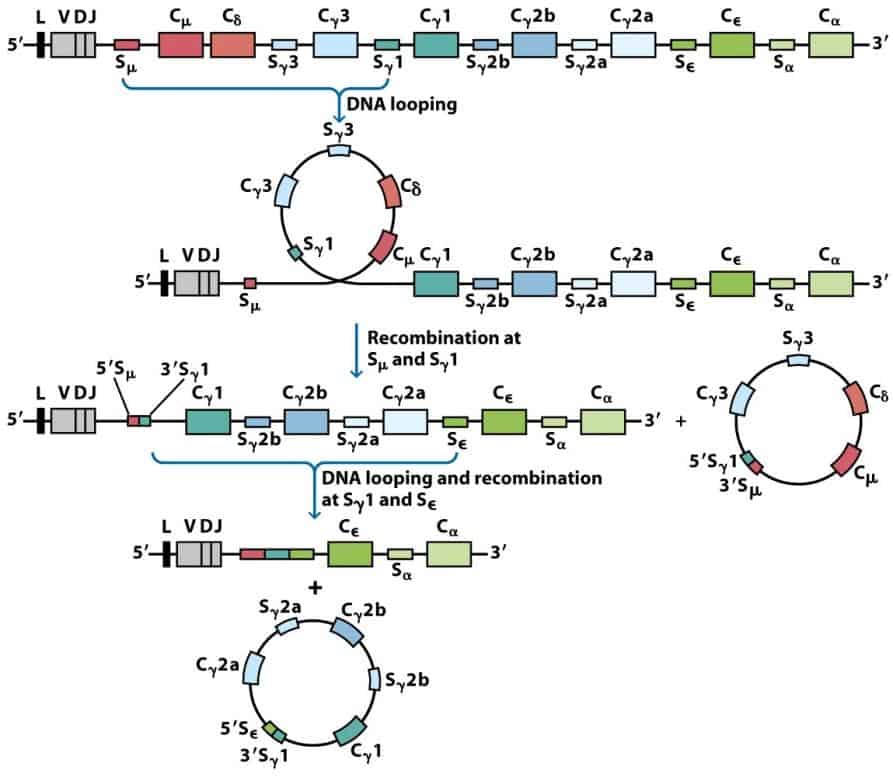
(Reproduced from Kindt T.J., Goldsby R.A., Osborne B.A. & Palacios R. (2007) Inmunología de Kuby (6th Ed.) McGraw-Hill Interamericana, Madrid.)
Isotype switching is a further DNA rearrangement process, and two essential requirements must be met for it to occur:
- The participation of recombination enzymes.
- The presence of repetitive nucleotide sequences called “switch signals”. These sequences lie in front of all the genes that encode the constant fragments, with the exception of IgD, and they “guide” the switch, indicating where recombination must take place, in which constant genes of the different heavy chains are progressively lost.
Isotype switching can occur multiple times in the life of a clone, but it is irreversible (if the switch has been from IgM to IgE, that cell will never produce IgM again). The limit is reached when the switch is to the IgA2 isotype (since the Cα2 gene is the last constant gene on chromosome 14).
Isotype switching is induced during cooperation between B and T cells; it is the T cells that signal to the B cells to rearrange their DNA towards new constant segments adjacent to the VDJ segments. These cells and their progeny switch from secreting IgM to other isotypes. This requires cell-to-cell contact between T and B cells, mediated by CD40L and CD40 respectively. In addition, the Th cell must receive two successive activation signals: the 1st occurs when the Th cell recognises the Ag + HLA class II complex (thanks to its receptor and its coreceptor, CD4), and the 2nd is the binding of CD28 to its ligand, which is CD80 and CD86 on the B cell.
After the Th cell has received these two signals, it sends two further signals for isotype switching in the B cell:
- First signal: surface expression of the CD40 ligand, which will bind to CD40 on the surface of the B cell.
- Second signal: release of cytokines that will bind to their receptors on the B cell.
Depending on the cytokine released, switching to different isotypes is induced (Figure 8.14):
- Interleukin-4: induces switching to IgE.
- Interferon-γ: induces switching to IgG.
- TGF-β (transforming growth factor β): induces switching to IgA.
- IL-4 + IL-13: NOT induce class switching.
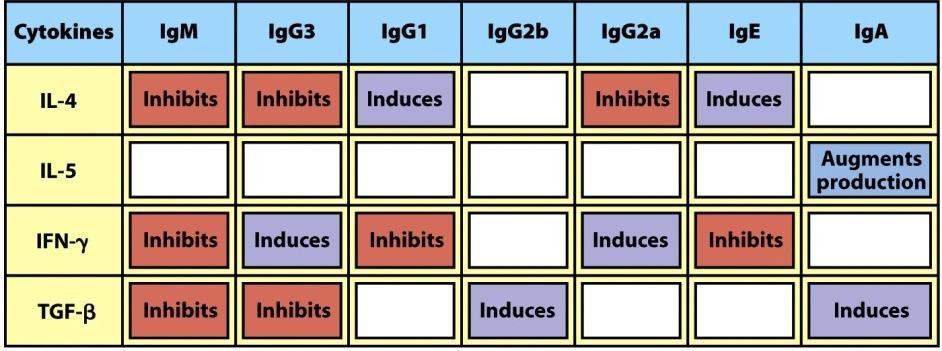
(Reproduced from Murphy K., Travers P. & Walport M. (2008) Janeway’s Immunobiology (7th Ed.) Garland Science, New York.)