Here is the outline explained in the previous video. If you have any questions, post them in the comments section at the bottom of the page.
Clinical applications of knowledge of HLA polymorphism
Association studies between HLA and disease
Certain human diseases occur more frequently in individuals who carry particular alleles of HLA genes. These diseases include susceptibility to infectious agents, a large number of disorders mediated by the immune system, such as autoimmune diseases, and some other clinical conditions. The association between HLA and non-monogenic diseases exploits the high polymorphism of the HLA system to support the diagnosis of certain diseases, although it must be borne in mind that such associations are not proof that can confirm a diagnosis on their own. The statistical association is not absolute, which indicates that other genes, as well as environmental factors, play a role in the pathophysiological mechanism of these diseases. Thus, expressing certain HLA antigens confers a degree of susceptibility but cannot ensure that the disease will develop.
The strength of an HLA association is expressed by the relative risk (RR) of developing a disease when an antigen is present in an individual compared with the risk of developing it when it is absent. The relative risk is therefore the strength of association of a disease with a particular HLA antigen or allele, and refers to the probability that a person will manifest a particular disease if a specific HLA allele is present. The higher the RR, the more significant the association.
A statistically significant increase in the frequency of an HLA antigen in a group of patients with a given disease is generally interpreted as evidence that it is associated with increased susceptibility to that disease. However, the study of HLA–disease relationships presents several problems:
- Alleles associated with a disease are also found in the normal population. The presence of an allele therefore does not mean that the disease will develop, and the disease may even appear in people who lack that allele.
- A single allele may be associated with more than one disease.
- In a given disease, 100% of cases are not associated with a single allele.
Some autoimmune diseases and their relationship to HLA serotype are briefly listed below (Figure 10.13):
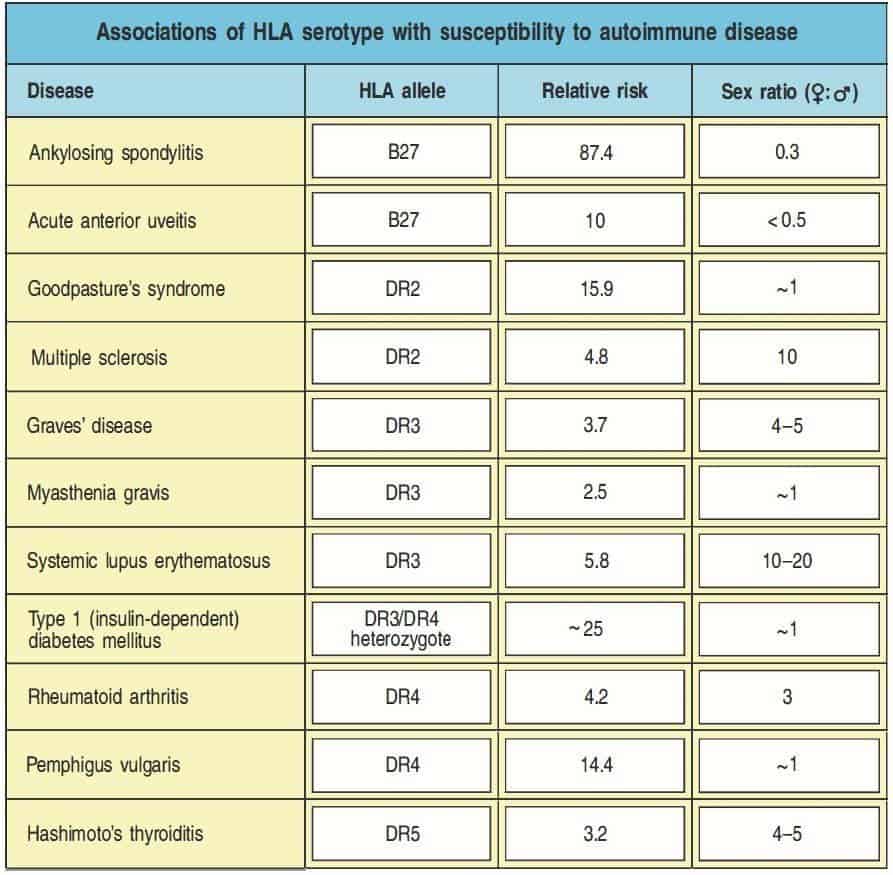
(Reproduced from Murphy K et al. (2012) Janeway’s Immunobiology (8th Ed.) Garland Science, New York.)
- Ankylosing spondylitis (AS): a chronic inflammatory disease of the spine, belonging to the group of seronegative spondyloarthropathies, which involves the sacroiliac joints and, less often, the peripheral joints, and progresses towards ankylosis (fusion of the joint elements with reduced range of movement). The aetiology is unknown, although genetic factors (HLA-B27, present in more than 90% of patients) and environmental factors (cross-reactivity with Klebsiella pneumoniae, enteric bacteria, etc.) have been identified. Of all HLA-B27-positive individuals, only 2% develop ankylosing spondylitis. HLA-B27 positivity is not a diagnostic criterion for spondylitis and is independent of the severity of the process. The disease is more common in males, usually appears between the ages of 15 and 30, and presents as low back pain, peripheral arthritis and osteoporosis. The most common extra-articular manifestation is acute anterior uveitis, in which the presence of HLA-B27 also plays an important role.
- Systemic lupus erythematosus (SLE): a chronic, multisystem inflammatory disease in which tissue damage is caused by the deposition of autoantibodies and immune complexes. The aetiology is unknown, although genetic factors (HLA-DR3, HLA-DR2 and HLA-B8), ethnic factors (three times more common in black people), hormonal factors (ten times more common in women of childbearing age), environmental factors (ultraviolet light, viruses, drugs, etc.) and immunological factors (alteration of all the elements of the immune system) have been implicated. The disease is more common in women and in black people, usually appears between the ages of 20 and 40, and can affect any system of the body, the most frequent being general disturbances (fever, asthenia, anorexia, weight loss and malaise), musculoskeletal (arthralgia and myalgia), cutaneous (photosensitivity) and haematological (pancytopenia).
- Autoimmune type 1 diabetes mellitus, or type 1A DM: a syndrome characterised by autoantibody-mediated destruction of pancreatic β cells, which causes an absolute deficiency of insulin. The aetiology is unknown, but genetic factors (HLA-DR3 and HLA-DR4, with an RR of 25 in heterozygotes) and environmental factors (viruses and foods) have been implicated. The disease has no sex predilection, usually appears between puberty and the age of 40, and presents abruptly with the cardinal features of diabetes (polyuria, polydipsia, polyphagia and weight loss).
Importance of the HLA system in organ transplantation
Transplantation is a process in which living cells, tissues or organs are taken from an individual, collectively called grafts, and transferred from one part of the body to another, or from one individual to another. Replacing an organ or tissue that no longer works aims to restore the recipient’s lost functions and correct the anatomical deficiency. For many patients, transplantation is the only alternative that can save their life and restore its quality. The individual who provides the graft is called the donor and the one who receives it the recipient or host.
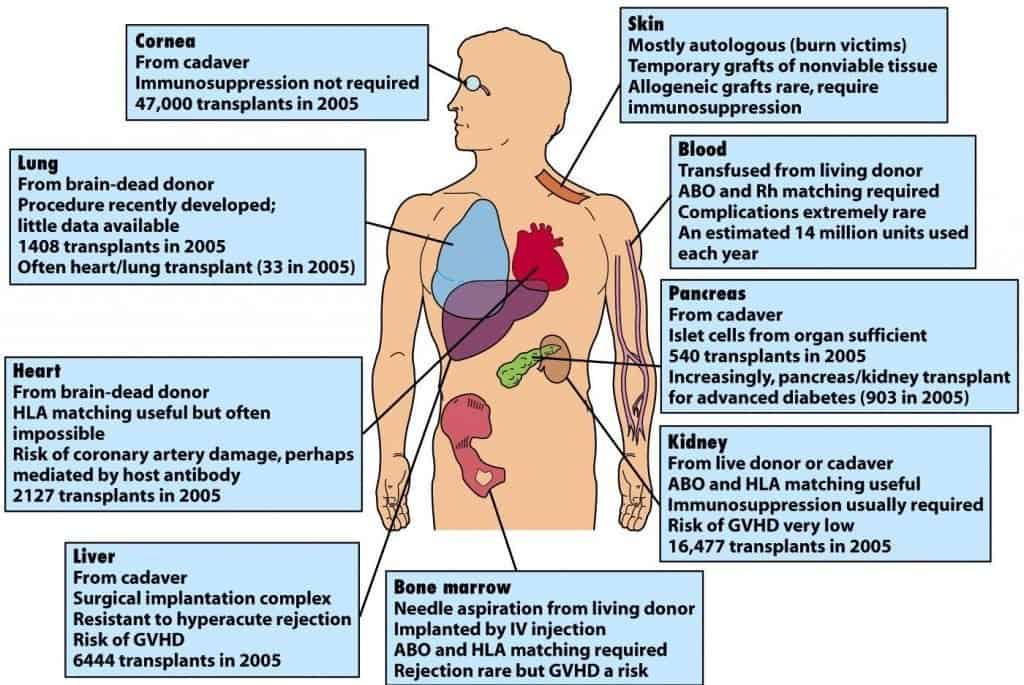
Today, transplants are performed of the heart, lung, liver, kidneys, intestine, pancreas, bone, skin, cornea, tendons, heart valves, cartilage and blood vessels (Figure 10.14). Depending on the new position adopted by the grafted cells, tissues or organs, two types of transplant are distinguished: orthotopic and heterotopic. In an orthotopic transplant the graft is placed in its normal anatomical position. In a heterotopic transplant the graft is placed in an anatomical position different from the normal one.
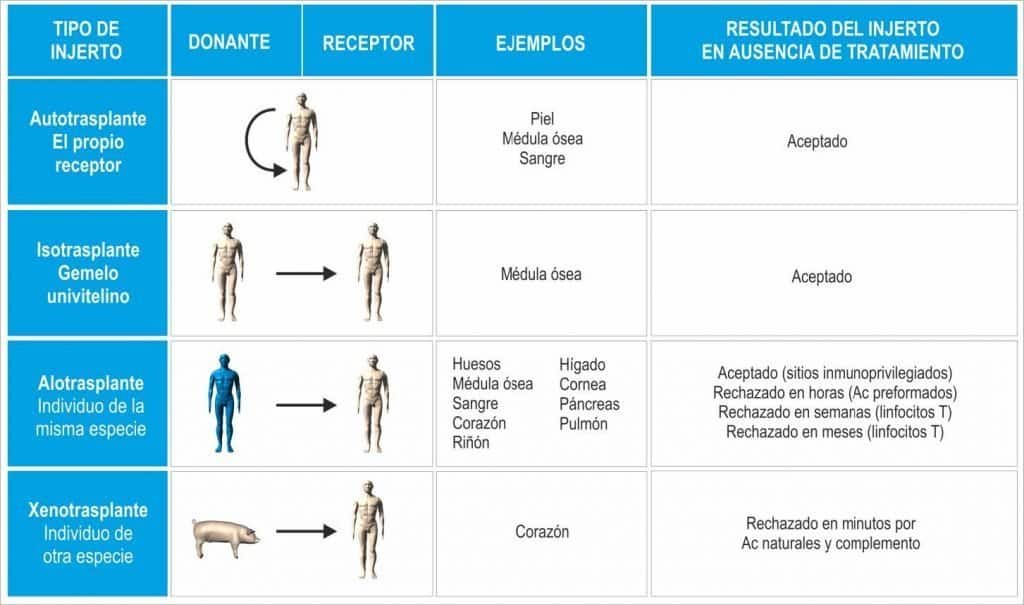
Depending on the relationship between donor and recipient, the following types of transplant are distinguished (Figure 10.15):
- Autograft: transplantation of tissue from one part of the body to another in the same individual. Autografts are always accepted, since donor and recipient are the same person. An example of an autograft is a skin graft.
- Isograft: a graft between two genetically identical, or syngeneic, individuals. An example of an isograft is a transplant between monozygotic twins. The specificity of the antigens involved in graft rejection is under genetic control. Genetically identical individuals have identical transplantation antigens, so grafts between them can be carried out without problems.
- Allograft: a graft between individuals of the same species, or allogeneic individuals, but with a different genetic make-up. The most common allograft is blood transfusion, which is the transplantation of circulating blood cells or plasma from one person to another and whose consequences, if incompatible, are disastrous.
- Xenograft: a graft between individuals belonging to different species, or xenogeneic individuals.
Clinical transplantation in humans consists of performing allografts, in which donor and recipient are in most cases genetically different individuals. It is precisely these genetic differences that are responsible for the recipient mounting an immune response of rejection directed against the foreign structures present on the donor graft cells, which in the clinic is prevented by the use of various immunosuppressive drugs.
Rejection of the grafted organ is caused by the genetic histoincompatibility between recipient and donor. Histoincompatibility between two individuals is due to two classes of antigens: major histocompatibility antigens, or human leucocyte antigens (HLA), and minor histocompatibility antigens, which include factors such as blood group or proteins encoded by genes on the Y chromosome. All these antigens are highly polymorphic proteins and very frequently occur in heterozygosity in the population. It is therefore very difficult to find matches at their loci between people who are not blood relatives.
(Reproduced from Kindt T.J. et al. (2007) Inmunología de Kuby (6ª Ed.) McGraw-Hill Interamericana, Madrid.)
(Reproduced from Regueiro J.R., López C., González S. & Martínez E. (2011) Inmunología. Biología y Patología del Sistema Inmune. (4ª Ed.) Editorial Médica Panamericana, Madrid.)
The main cause of rejection is the high polymorphism of the human leucocyte antigens (HLA). Histocompatibility antigens are key to the normal functioning of the immune system and small differences between the structure of the donor’s and the recipient’s antigens can often trigger an intense immune response against the transplanted organ. Various studies have shown that, for most solid organs (kidney, heart, lung, pancreas, etc.), the greater the histocompatibility, that is, the smaller the differences between the donor’s and the recipient’s HLA molecules, the better the patient’s prognosis and course after transplantation (Figure 10.16).
Among the major histocompatibility antigens, the most decisive element for rejection to develop is HLA class II molecules. Antigens presented by HLA class II molecules are recognised by CD4+ T cells (helper), whereas antigens presented by HLA class I molecules are recognised by CD8+ T cells (cytotoxic). Activation of CD8+ T cells requires prior activation of CD4+ T cells, so a greater contribution to the development of rejection can be attributed to HLA class II molecules, as can be seen in Figure 10.16. It is therefore essential to ensure a match between the donor’s and the recipient’s HLA class II loci so as to minimise the intensity of rejection.
Nevertheless, HLA class I molecules are also important for the survival of the graft and of the individual. In this case, the absence of the recipient’s HLA class I molecules on the graft cells can be recognised by the killer-cell inhibitory receptors (KIR) of NK cells and lead to the death of the foreign cell.
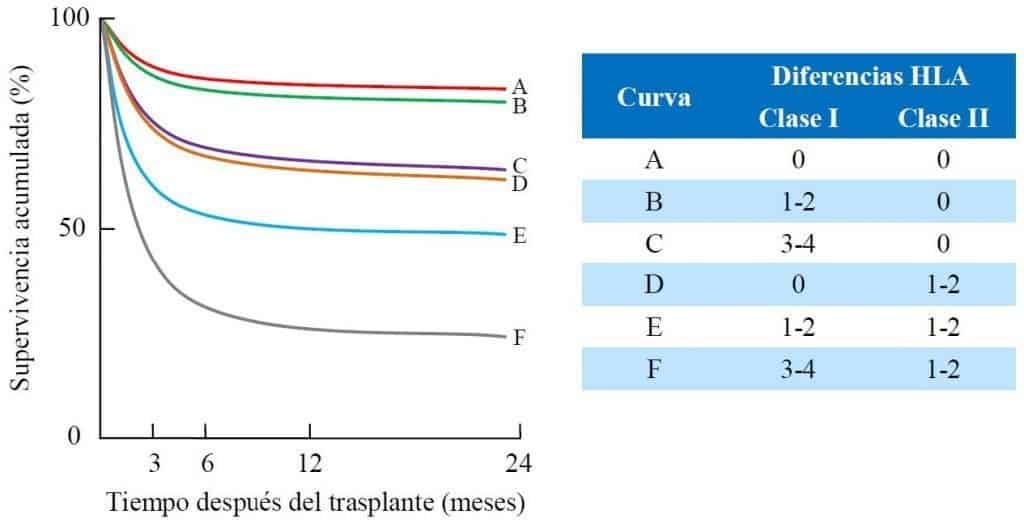
Effect of the number of differences in HLA class I and class II antigens between donor and recipient on kidney transplant survival. One or two differences in HLA class I molecules have little effect on survival. A single difference in HLA class II antigens (curve D) has the same effect as 3–4 differences in class I antigens (curve C). When class I and class II antigens both differ, transplant rejection occurs faster. (Reproduced from Pérez Torres D. et al. (2010) Sistema
HLA y su importancia en el trasplante de órganos sólidos. Universidad de Valladolid, Valladolid.)
Usefulness of the HLA system in legal and forensic medicine
HLA antigens have been used in legal and forensic medicine techniques to identify individuals, to resolve cases of uncertain paternity and in criminal cases.
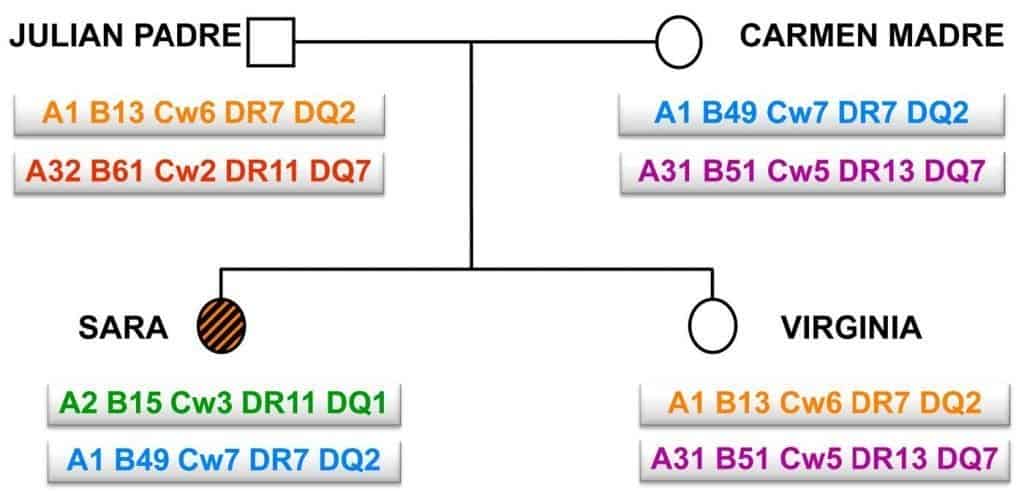
Paternity tests based on the HLA system rely on the inheritance pattern of MHC genes. In this example, Sara can be seen to be the daughter of Carmen but not of Julián.
Virginia, for her part, is the daughter of both parents. (Courtesy of David Pérez Torres and Alfredo Corell Almuzara, University of Valladolid.)