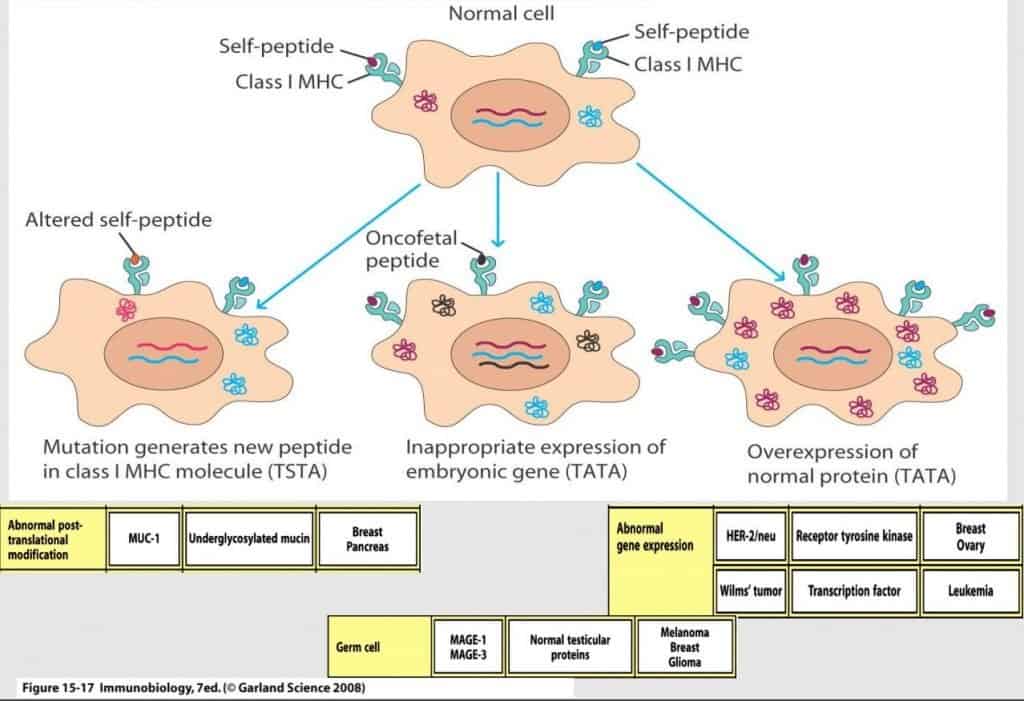
A tumour originates from a healthy cell that undergoes changes. It can then be detected and destroyed by the immune system. But if it escapes immune surveillance, the tumour cell begins to grow and multiply, generating a tumour. If the cells do not leave the tissue in which they originated they form a benign tumour, which is confined to the tissue. But if they manage to cross the epithelial barriers and infiltrate other tissues, invasive tumours result. If in addition the cells reach the vessels and invade other tissues, metastasis arises.
An epithelial cell becomes a tumour cell and proliferates. If the cell line reaches the subepithelial lamina ➡ it becomes malignant ➡ spread via the blood ➡ metastasis.
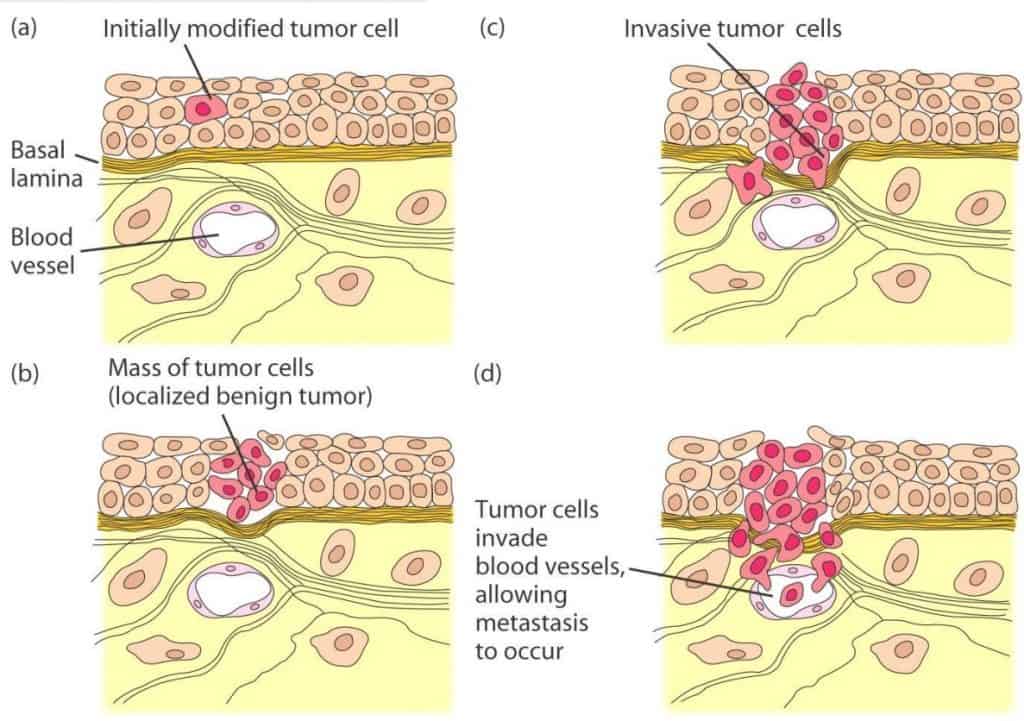
The immunological tools against tumours are:
When these transformations of healthy cells into tumour cells take place, in principle nothing happens, because the cells fall into the hands of CD8+ lymphocytes or NK cells. NK cells and CD8+ lymphocytes must act, and do act, against tumour cells, through a response controlled by CD4+ lymphocytes. However, tumour cells keep changing and evolving and evade immune surveillance, since they have mechanisms for going unnoticed.
In some cases they can attract regulatory T lymphocytes, which position themselves around the tumour cells and inhibit the immune response by secreting cytokines that inhibit the immune system. In this way they prevent the action of CD8+ T lymphocytes and NK cells, ensuring the tumour's growth.
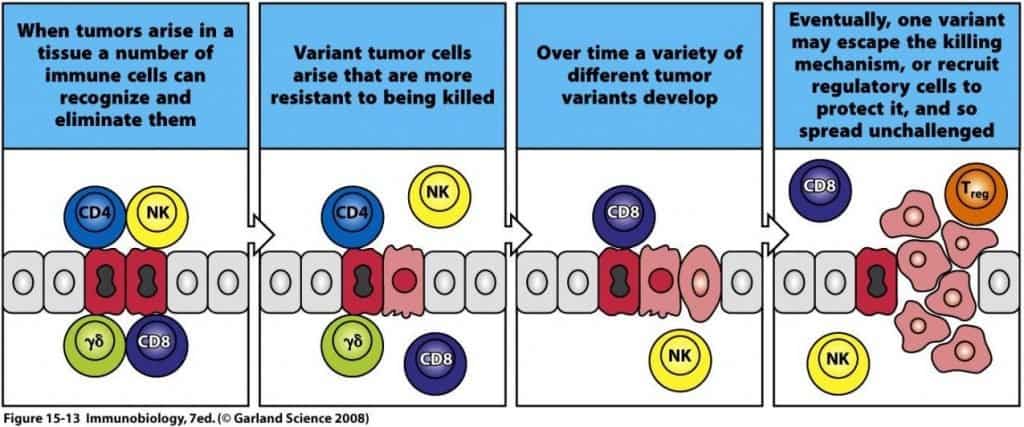
Immune evasion mechanisms
Some tumours synthesise barrier proteins that wrap around the tumour, isolate it and turn it into an immune-privileged tissue. Others secrete proteins that inhibit NK cells and Tc lymphocytes.
In other cases, the cell endocytoses the antibodies. And in others, the cell endocytoses the HLA antigens, so that it cannot be identified by Tc lymphocytes.
- They do not express HLA on the surface or costimulatory molecules such as CD80/86.
- Antigenic modulation: the cells do not like being touched, and if the tumour antibody arrives, they phagocytose it.
- Instead of stimulating CD or NK cells, they stimulate Treg cells, which release IL-10 and TGFβ, which inhibit the inflammatory response.
- Building a barrier to avoid immune surveillance.
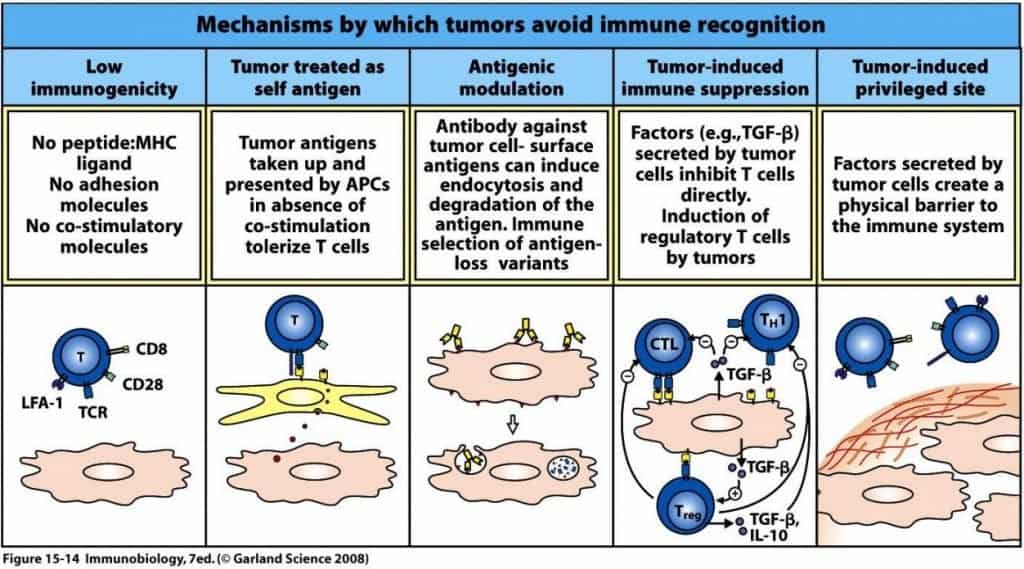
Tumour antigens
What happens for a healthy cell to become a tumour cell?
- Altered self proteins: one of the body's own proteins alters its glycosylation pattern. Its sequence does not change and there are no mutations; instead the external carbohydrates change (they appear hypo- or hyperglycosylated). This happens, for example, with mucins (MUC-1) in some cases of breast cancer.
- Inappropriate proteins: embryonic proteins that stop being expressed in adult life are expressed again. These are the oncofetal antigens. (Breast cancer and melanoma)
- Proteins expressed outside their tissue or at the wrong time.
- Overexpressed normal proteins: in breast cancer, the HER2 receptor is expressed in an uncontrolled way. This type of breast cancer is the least dangerous because it has a very good immune-based treatment.
- Chromosomal translocation, for example the Philadelphia chromosome, which causes leukaemias.