The immune system evolved to fight infections caused by viruses, bacteria, protozoa, fungi and helminths. It consists of a set of mechanisms that protect the body against elements that threaten its integrity.
To do so, the immune system works by recognising and discriminating self from non-self.
How does the immune system distinguish self from non-self?
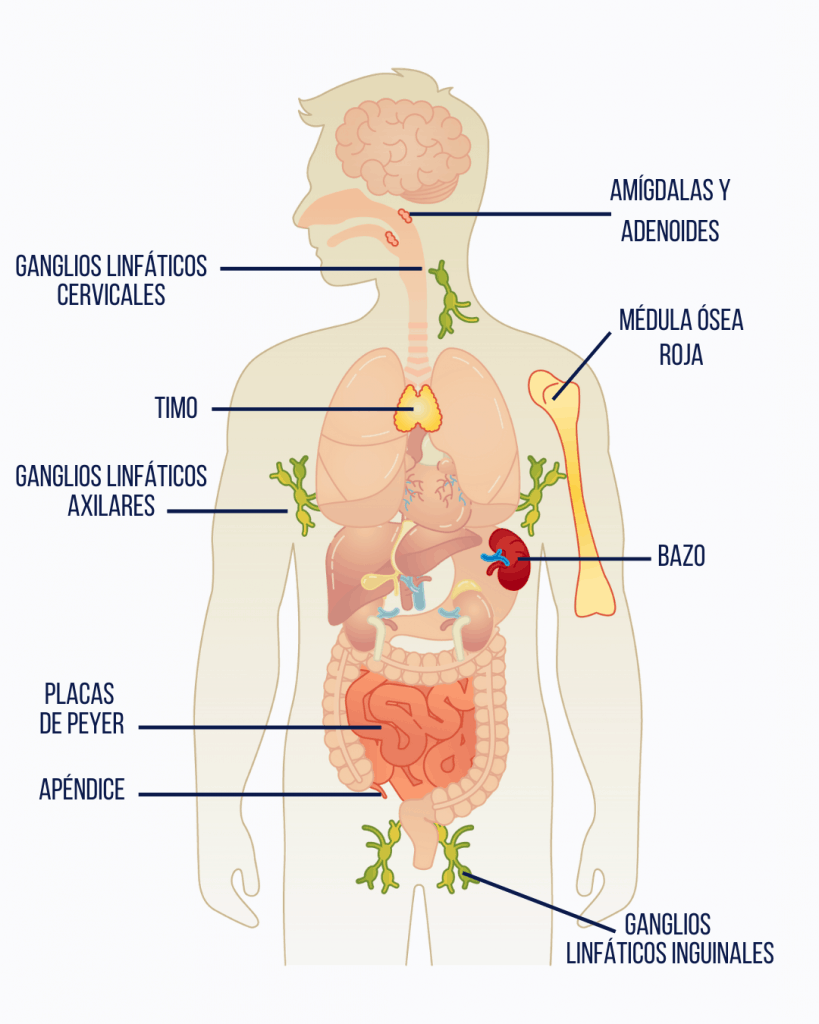
The immune system is educated in different tissues so that it can discriminate between self and non-self. In addition, its cells undergo a selection process, so that those unable to tell self elements from foreign ones are eliminated and do not enter the
circulation. T cells are educated in the thymus and selected in the thymus and lymph nodes, whereas B cells are educated and selected in the bone marrow (Figure 1).
What do lymphocytes learn in the educating organs?
Lymphocytes learn what is self, thereby acquiring the ability to discriminate what is foreign. Education also involves acquiring immunological memory. Learning makes it possible to eliminate useless or potentially self-destructive cells. Only a small percentage
of lymphocytes are useful and are therefore retained.
Useful lymphocytes are selected in several stages. A lymphocyte's ability to bind a self-antigen can be fatal and, in this case, the cell must be eliminated (negative selection). By contrast, when a lymphocyte's ability to bind a self-antigen is necessary, the cell is perpetuated (positive selection).
How is the immune system able to recognise so many antigens?
T and B cells are organised into clones. A clone is a group of cells with a single surface receptor specific for a particular antigen. Clones are preformed and are activated only when the antigen capable of activating them comes into contact with them. There are estimated to be around 10¹¹ clones of T and B cells, able to recognise a similar number of antigens. The set of clones of an individual constitutes the lymphocyte repertoire.
Only clones able to identify and specifically bind an antigen will be activated. This is the basis of the specific, or adaptive, immune response. When an infection occurs, only the lymphocyte clones with receptors specific for the antigens of the invading pathogen are mobilised, so most of the preformed clones will never be activated. This property of the immune system is called specificity.