Mechanisms of activation of CD8+ T cells
They are involved in infections by intracellular pathogens such as viruses, and they also act against tumour cells.
All cells of the body can be monitored by CD8 cells and destroyed, since all of them express MHC class II antigens on their membrane.

CD8 T cells are activated by three pathways:
1- Direct activation by APCs (intense costimulation).
- CD8+ T cells can be activated directly by an APC with high levels of costimulatory molecules (mainly CD80). The interaction of CD28 (on the lymphocyte membrane) with CD80/86 induces the synthesis of IL-2 and the cytolytic function of the CD8+ T cell, which destroys the antigen-presenting cell and other cells infected by the same virus.
2- A Th1 cell increases the costimulatory activity of the APC
- When costimulation is weak, cytotoxic T (Tc) cells need the presence and collaboration of Th1 cells, which must recognise antigens of the same pathogen. Binding to the Th1 cell can induce an increase in the costimulatory activity of the presenting cell, which is then able to activate the Tc cell, as in the previous case.
3- An activated T cell synthesises IL-2.
- The Th1 cell activated by the presenting cell can synthesise IL-2, which is able to induce differentiation into an effector Tc cell, which destroys the infected cell.
Mechanisms of lysis mediated by CD8+ T cells
They eliminate cells infected by intracellular pathogens (viruses) and tumour cells.
- By direct contact, through recognition of the MHC class I–antigenic peptide complex, which allows these cells to distinguish between infected and healthy cells. When the cell recognises this complex, it polarises the TCR and soluble factors towards the site of contact with the antigen (immunological synapse), which increases the precision of lysis. They express on their membrane a protein called CD95L which, on interacting with CD95 on the target cell, induces its apoptosis.
- Production of cytolysins. Tc cells secrete perforins, which form pores in the membrane (similar to complement protein C9), and granzymes, which induce apoptosis (in the same way as CD95).

They can also cause cell lysis through the secretion of TNF-β and IFN-γ, which activate phagocytic cells, and these produce more IFN-γ. This occurs mainly on NK cells, although they use different activation pathways.
Through mechanisms of lysis very similar to those of NK cells, but the activation pathway is completely different, since NK cells do not express a TCR.
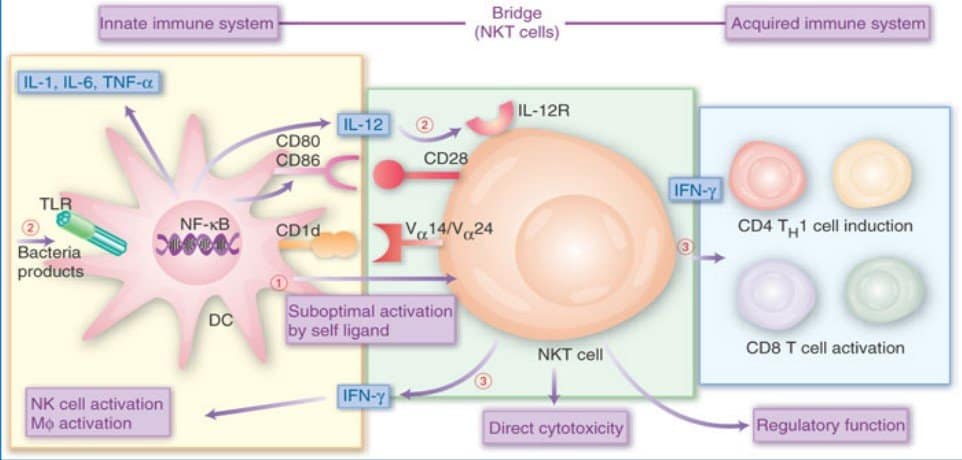
NKT CELLS: another lineage of effector lymphocytes
These cells act as a bridge between innate and adaptive immunity. They have a TCR with an invariant alpha chain, which recognises certain characteristic molecules: glycolipids presented by CD1d molecules (the 3rd pathway of antigen presentation). They also carry NK markers. They do not form memory cells.
Depending on the degree of stimulation:
- They have direct cytolytic capacity
- They induce the activation of Th1 cells and effector CD8+ cells (via IFN-γ).
- They activate NK cells and macrophages (via IFN-γ).
- They regulate anti-infectious and anti-tumour immune responses.