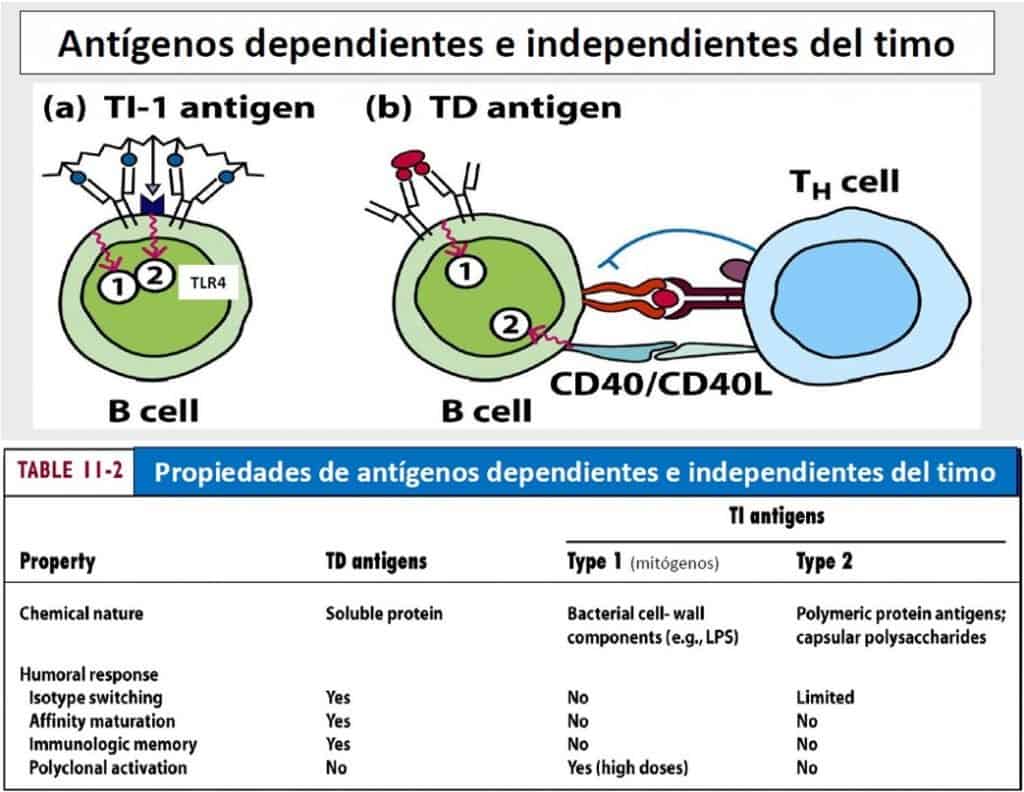
So far, all the processes we have discussed refer to thymus-dependent antigens, that is, a B cell will only produce antibodies, after first differentiating into a plasma cell, if it has the help of a T cell; for this reason these are called T-dependent. However, there is another type of antigen that is thymus-independent, that is, proteins or polypeptides that, on binding to the BCR, can activate the B cell without the help of T cells. We can also say that they stimulate strong antibody responses in athymic individuals. The LPS of gram-negative bacteria are able to activate non-specifically every B cell they come across, using TLR4 as receptors. These thymus-independent antigens can be divided into two groups.
Type 1 antigens
The independent antigens here are the lipopolysaccharides; they are mitogens, polyclonal structures that, on binding to B-cell receptors, activate the cells non-specifically. They do not undergo isotype switching or somatic hypermutation; these are responses that are activated polyclonally, that is, they have a certain intrinsic activity that can directly induce B-cell activity. At high concentrations these molecules induce the proliferation and differentiation of almost all B cells, regardless of their specificity for the antigen.
Type 2 antigens
There is another type that are not mitogens. These are the ones that activate B-1 cells, for example the capsule of some microorganisms, which have very repetitive structures. These antigens have no intrinsic B-cell-stimulating activity and, in addition, whereas TI-1 antigens can activate both mature and immature B cells, these only activate mature B cells; immature cells are inactivated by repetitive epitopes. It should therefore be noted that the density of TI-2 antigens presented to B cells is crucial: if it is too low, the cross-linking between receptors is insufficient, and if it is too high, the B cell becomes anergic.