We are going to look in depth at two of the effector functions of antibodies that we saw in the previous lesson:
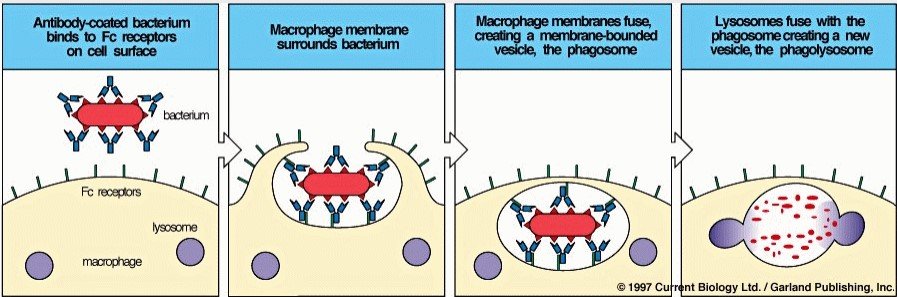
Opsonisation
The binding of the antibody, through its Fab fragment, to viral or bacterial surfaces (specific Ag) produces a conformational change in the Fc portion. Phagocytic cells have Fc receptors that bind to this portion, facilitating phagocytosis of the microorganisms coated with antibody.
In addition, the binding of the antibody to the microbial surface activates complement: some fragments (C3b, C4b) now coat the surface of the pathogen and promote phagocytosis through specific receptors (CRs) on cells of innate immunity.
Antibody-dependent cell-mediated cytotoxicity
It can be mediated by several cell types, all of which recognise the presence of the Fc portion of antibodies on the surface of target cells (eosinophils, neutrophils, NK cells, macrophages).
The mechanism by which they are set in motion is similar and the receptor is common, but each cell carries out its function in a different way: destruction of the target cell by releasing lytic enzymes and, on some occasions, TNF-α.
- In the case of eosinophils: their activation involves the release of perforins and lytic enzymes. They are involved in responses against parasites. They release the entire content of their granules to the outside.
- Neutrophils release lytic enzymes contained in their intracellular granules.
- NK cells release perforins, granzymes and cytokines (TNF-α), which cause destruction of the pathogen or act as chemotactic factors.
- Macrophages also release TNF-α and lytic enzymes but do not release granzymes.
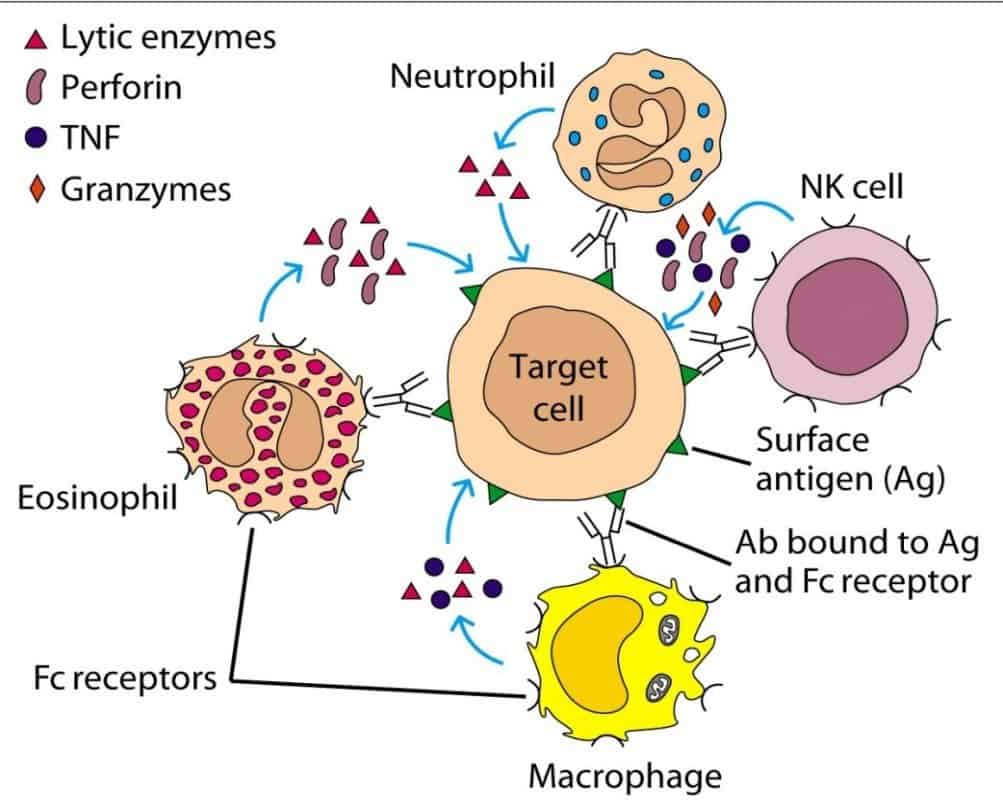
The cell does not specifically recognise the antigen; it recognises the Fc portion of the Ab. It is a non-specific mechanism, although it uses the same tools as CD8 lymphocytes.