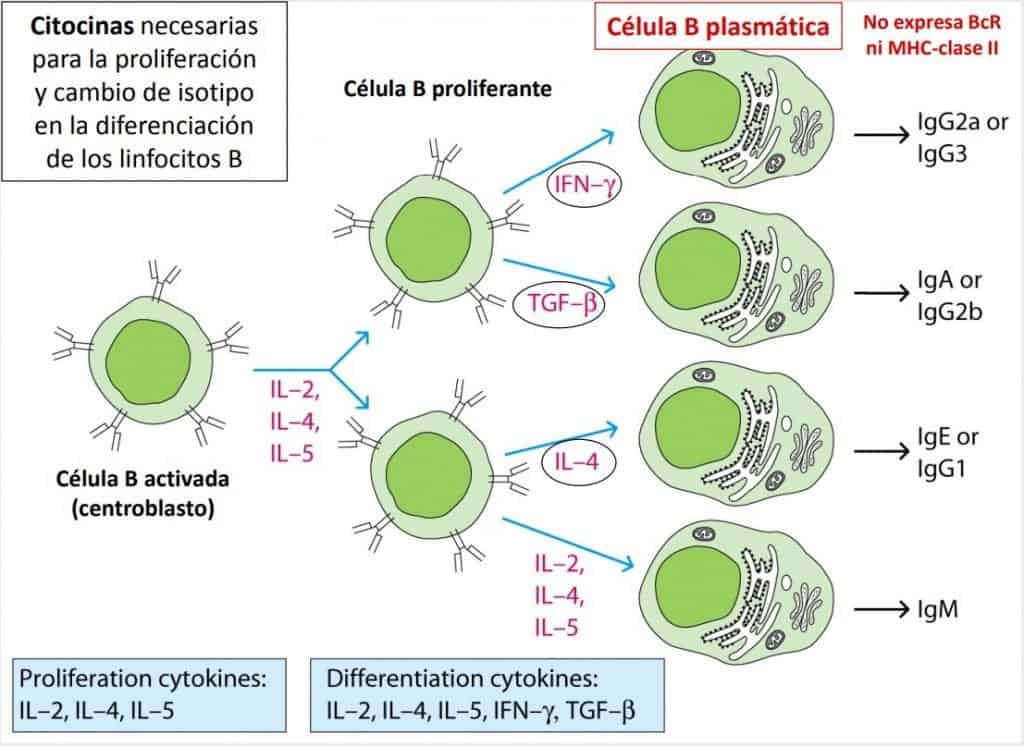
Isotype switching takes place in antigen-activated B cells and is regulated by helper T cells (Th1 and Th2). The help provided by the Th cell to the B cell is delivered at two levels: one involves direct contacts through CD40/CD40L and the other is controlled by soluble factors (cytokines). Some of these cytokines are the same ones that were involved in inducing B-cell proliferation (IL-4).
By cytokines
While the need for direct contacts appears to be universal for all isotypes, certain cytokines induce switching to a particular isotype.
All cytokines act in the same way: they make the specific S recombination sites (switch regions), located upstream of the constant genes of the immunoglobulin heavy chains, accessible to recombinases.
Th cells therefore regulate both the production of antibodies by B cells (Th2) and their isotype (Th1 and Th2), which determines the effector function of the antibody. Isotype switching does not change the specificity but the effector function, since the genes of the variable fragments are not modified.
The fragment that is lost through the action of the recombinases means the loss of the genes of certain isotypes, so that these can no longer be synthesised by the cell.
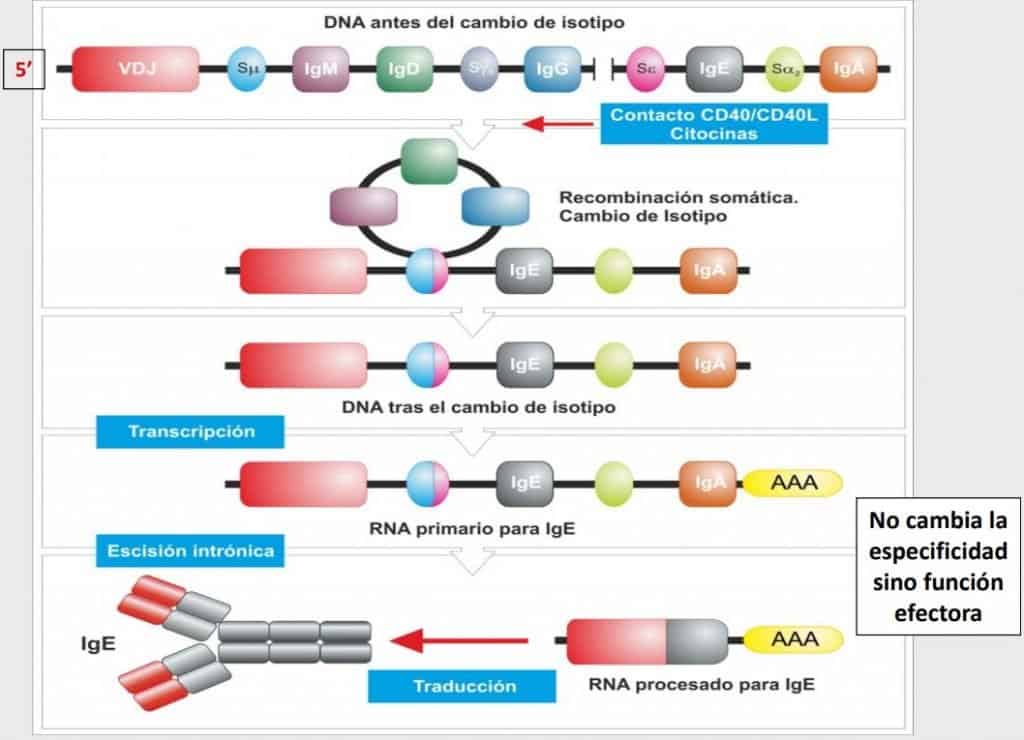
By CD40L/CD40
The most important contact activation pathway is the one mediated by the CD40L/CD40 pair (on T cells and B cells respectively). CD40L is essential for isotype switching in B cells: individuals deficient in this molecule synthesise only IgM.
When the lymphoblast enters the germinal centre, it will find that other cells have in turn produced cytokines, which will determine the type of antibody.
- When the lymphocyte is activated, it has to try to produce antibodies in a primary response, which is an IgM response: antibodies that are not very active, with low-to-intermediate affinity. If IL-2, IL-4 and IL-5 are present in the environment, there is no change of antibody.
- If IFN-γ is produced, it causes IgG2a or IgG3 to be secreted, which are important in the immune response against infectious pathogens.
- If TGF-β is present, production of IgA or IgG2b is induced.
- In the case of IL-4, IgE or IgG1 is produced.