Here is the outline explained in the previous video. If you have any questions, post them in the comments section at the bottom of the page.
The lytic pathway
The formation of the C3 convertases is the point of convergence of the three complement activation pathways. From here on, the convertase of the classical and lectin pathways (C4b2b) and the convertase of the alternative pathway (C3bBb) set off a series of common events that are collectively called the lytic pathway or common terminal pathway. The common terminal pathway allows the formation of a membrane attack complex (MAC), which creates a pore in the lipid bilayer of the pathogen, disrupting its integrity and causing an osmotic shock that leads to the death of the microorganism.
The first step in the formation of the MAC is the formation of the C5 convertases (Figure 11.10). The C5 convertase of the classical and lectin pathways is formed by the binding of C3b to C4b2, giving rise to C4b2b3b. The C5 convertase of the alternative pathway is formed by the binding of C3b to C3bBb, giving rise to C3bBb3b (or C3b2Bb). Either of the C5 convertases can bind and cleave C5 thanks to the binding site available for this on C3b and to the serine protease activity of C2b or Bb. This reaction produces C5a and C5b. From this point on, the remaining components are added in series (Figure 11.11).
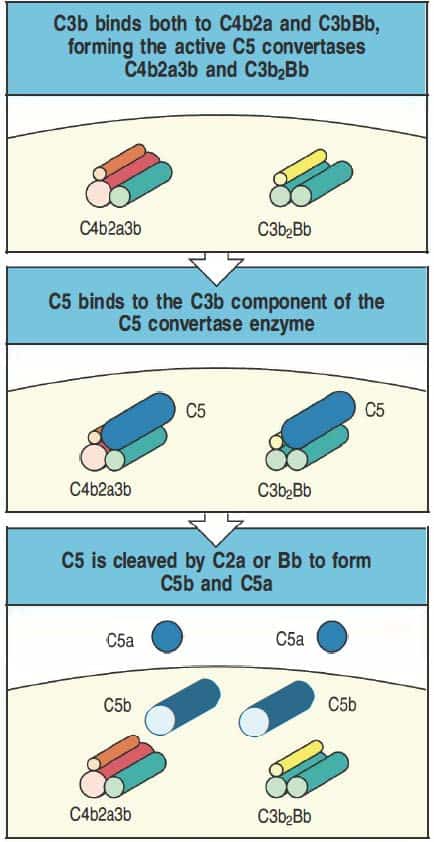
(Reproduced from Murphy K et al. (2012) Janeway’s Immunobiology (8th Ed.) Garland Science, New York.)
In the following steps, C5b initiates the assembly of the components that will form the MAC and directs their insertion into the cell membrane. First, C5b binds to the molecule C6, and the C5b6 complex binds to a molecule of C7. This reaction triggers a conformational change in the molecules that form the complex, exposing a hydrophobic site on C7 that allows the complex to insert into the lipid bilayer.
Next, C8, a complex formed by the proteins C8β and C8α-γ, binds through its C8β portion to the C5b portion of the C5b67 complex, so that the hydrophobic domain of the C8α-γ portion allows insertion into the lipid bilayer.
Finally, C8α-γ induces the polymerisation of between 10 and 16 molecules of C9 to form a structure called the membrane attack complex (MAC). The MAC has a hydrophobic outer region, which allows it to associate with the lipid bilayer, and an inner hydrophilic channel 100 Å in diameter, which allows water and solutes to pass freely through the lipid bilayer. Disruption of the lipid bilayer causes loss of cellular homeostasis and of the proton gradient across the membrane, and allows proteolytic enzymes to enter, ending in the destruction of the pathogen.
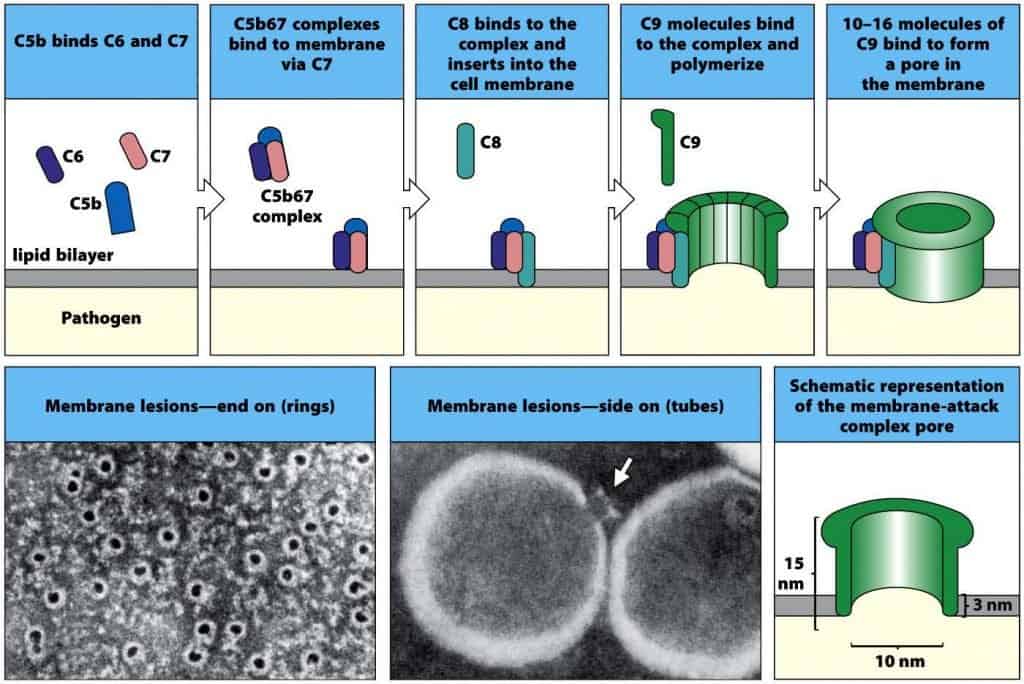
(Reproduced from Murphy K et al. (2012) Janeway’s Immunobiology (8th Ed.) Garland Science, New York.)
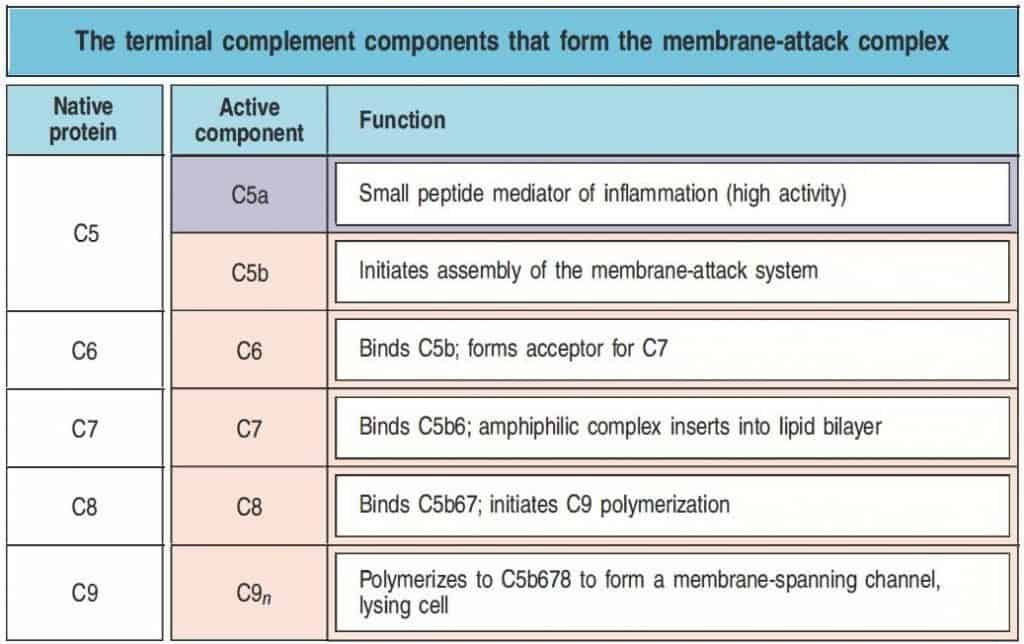
(Reproduced from Murphy K et al. (2012) Janeway’s Immunobiology (8th Ed.) Garland Science, New York.)