In this lesson we will look at what the facial muscles are and their anatomy.
Remember that this lesson is part of the free courses from Paradigmia. Access the full course here ▶️ HUMAN ANATOMY COURSE ◀️
- What are the facial muscles?
- List of facial muscles
- Occipitofrontalis muscle.
- Orbicularis oculi muscle
- Corrugator supercilii muscle
- Transverse nasal muscle
- Depressor septi nasi muscle (myrtiform)
- Dilator naris muscle
- Orbicularis oris muscle
- Buccinator muscle
- Levator labii superioris muscle
- Levator anguli oris muscle
- Zygomaticus major and minor muscles
- Risorius muscle
- Depressor anguli oris muscle
- Depressor labii inferioris muscle
- Mentalis muscle
- Platysma muscle
- Recommended reading on the facial muscles
What are the facial muscles?
The facial muscles are muscles with bony and cutaneous attachments that move the skin of the facial region, changing expression or the degree of opening of the mouth and eyelid openings. We distinguish:
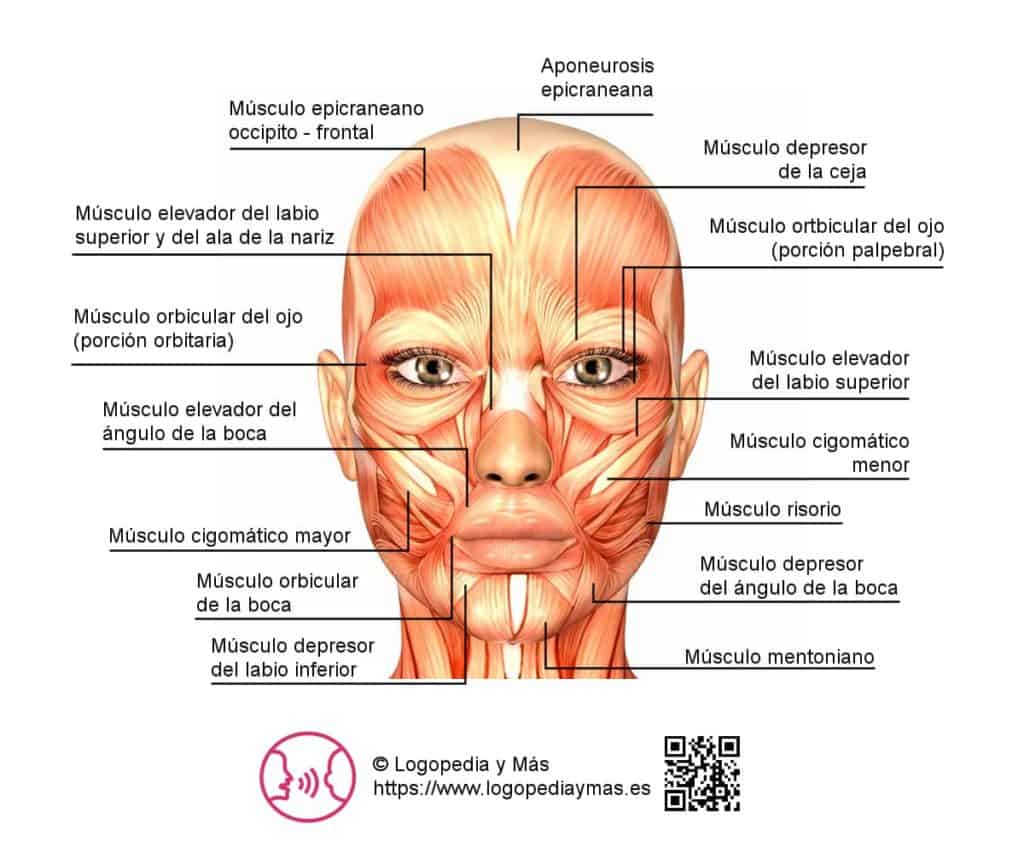
List of facial muscles
Occipitofrontalis muscle.
It has an occipital part that attaches to the superior nuchal line and a frontal part that attaches to the skin of the forehead and the superciliary arches; an epicranial aponeurosis joins the two parts. Its contraction raises the scalp and wrinkles the forehead.
Orbicularis oculi muscle
This circular muscle encircles the palpebral fissure, and its function is to regulate how far it opens, while also helping to distribute the tears.
Corrugator supercilii muscle
It attaches to the frontal bone and runs upwards and outwards, ending in the skin of the eyebrow. When it contracts, it draws the eyebrow downwards and inwards.
Transverse nasal muscle
It runs from the dorsum of the nose to the skin of the nasogenian groove. Its contraction widens the nostrils.
Depressor septi nasi muscle (myrtiform)
It runs from the canine fossa to the lower part of the ala of the nose. When it contracts, it closes the nostrils.
Dilator naris muscle
It runs from the upper border of the alar cartilage to the skin lateral to the nose. It dilates the nasal opening.
Orbicularis oris muscle
This is a circular muscle that surrounds the oral fissure, regulating its opening and closing. Its peripheral margin serves as an attachment for other muscles of facial expression.
Buccinator muscle
Already studied in the lesson on the masseter muscle. It regulates the degree of distension of the cheek.
Levator labii superioris muscle
It runs from the infraorbital margin and the nasal bones to the deep part of the upper lip. It raises the lip and also the ala of the nose.
Levator anguli oris muscle
It runs from the canine fossa to the skin of the corner of the mouth. Its contraction raises the corners of the mouth.
Zygomaticus major and minor muscles
They run from the zygomatic (malar) bone to the corner of the mouth. They retract and raise the corners of the mouth.
Risorius muscle
The facial muscle risorius runs from the skin of the parotid region to the skin of the corner of the mouth. Its action is to retract the corner of the mouth.
Depressor anguli oris muscle
Also called the triangularis muscle of the lips. It runs from the outer surface of the mandible to the corner of the mouth. Its contraction depresses and retracts the corner of the mouth.
Depressor labii inferioris muscle
Or quadratus menti. It runs from the mandible to the skin of the lower lip. Its contraction lowers the lower lip.
Mentalis muscle
It runs from the mandible to the lower part of the skin of the chin. Its contraction raises the chin.
Platysma muscle
A sheet of muscle that covers the lateral part of the neck between the superior thoracic aperture and the skin overlying the mandible. It depresses the corner of the mouth.